Gravitational Forces in 2D definitions Flashcards

Gravitational Forces in 2D definitions
Control buttons has been changed to "navigation" mode.
1/15
  • Vector Addition
    A method to calculate net forces by combining vectors, considering both magnitude and direction.
  • Vector Decomposition
    Breaking a vector into its x and y components using trigonometric functions.
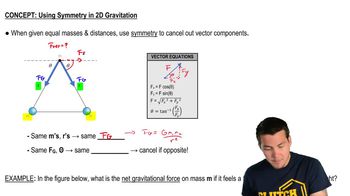
  • Symmetry
    A property used to simplify calculations by recognizing equal and opposite forces that cancel out.
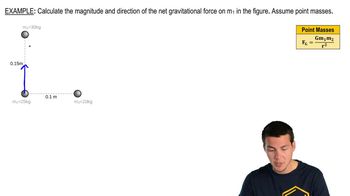
  • Net Gravitational Force
    The combined gravitational effect of multiple masses on a single mass, calculated using vector addition.
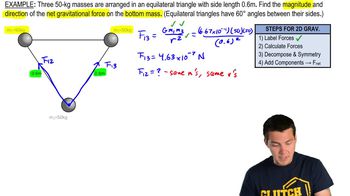
  • Equilateral Triangle
    A triangle with all sides and angles equal, often used in problems to simplify force calculations.
  • Newton's Law of Gravitation
    A formula to calculate gravitational force between two point masses based on their masses and distance.
  • Pythagorean Theorem
    A mathematical principle used to calculate the magnitude of a vector from its components.
  • Inverse Tangent
    A trigonometric function used to determine the angle of a vector from its components.
  • Gravitational Force
    The attractive force between two masses, proportional to their masses and inversely proportional to the square of the distance between them.
  • Components
    The projections of a vector along the x and y axes, used in vector decomposition.
  • Angle Theta
    The angle used in vector decomposition, typically measured from the x-axis.
  • Opposite Interior Angles
    Angles formed between parallel lines and a transversal, used to determine angles in vector problems.
  • Coordinate System
    A reference framework consisting of x and y axes used to define vector components.
  • Sine and Cosine
    Trigonometric functions used to calculate the components of a vector.
  • Magnitude
    The size or length of a vector, calculated using the Pythagorean theorem for its components.