How does your mass on the Moon compare to your mass on Earth?
Your mass remains the same on the Moon as it is on Earth, because mass is an intrinsic property of matter and does not depend on location.
What is the only force that acts on an object in free fall (neglecting air resistance)?
Gravity is the only force acting on an object in free fall when air resistance is neglected.
What is the only force acting on an object orbiting Earth (neglecting air resistance)?
The only force acting on an object orbiting Earth is gravity.
In the context of gravitational equilibrium, what two quantities are balanced?
In gravitational equilibrium, the inward gravitational force and the outward pressure (such as thermal or radiation pressure in stars) are balanced.
Where will a spacecraft be when the gravitational forces from two bodies acting on it are equal?
A spacecraft will be at a point along the line connecting the two bodies where the magnitudes of the gravitational forces from each body are equal.
What event is responsible for causing tides on Earth?
Tides are caused by the gravitational pull of the Moon (and to a lesser extent, the Sun) on Earth's oceans.
How can you determine if a gravitational force field diagram is drawn correctly?
A correct gravitational force field diagram shows vectors pointing toward the mass creating the field, with the magnitude of the vectors decreasing as the distance from the mass increases.
How can an astronaut prevent themselves from floating away in space?
An astronaut can prevent floating away in space by securing themselves to a spacecraft or structure using tethers or handholds.
How can the gravitational force between two objects be decreased?
The gravitational force between two objects can be decreased by increasing the distance between them or by reducing the mass of one or both objects.
In which direction is Earth's gravitational force always directed?
Earth's gravitational force is always directed toward the center of the Earth.
What causes the Moon to always keep the same face toward Earth?
The Moon always keeps the same face toward Earth due to synchronous rotation, where its rotational period matches its orbital period around Earth.
What happens to the mass of a ball if it is moved from Earth to the Moon?
The mass of the ball remains unchanged when moved from Earth to the Moon.
Which force always pulls downward on objects near Earth's surface?
Gravity always pulls downward on objects near Earth's surface.
What happens to the gravitational pull between two bodies as the distance between them increases?
The gravitational pull between two bodies decreases as the distance between them increases, following an inverse square law.
What is the relationship between gravity and mass?
The gravitational force between two objects is directly proportional to the product of their masses.
What quantity is inversely proportional to your weight on a planet's surface?
Your weight on a planet's surface is inversely proportional to the square of the planet's radius.
Why does one side of the Moon always face away from the Earth?
One side of the Moon always faces away from Earth because the Moon's rotation period is equal to its orbital period, resulting in synchronous rotation.
What is the term for the downward pull on an object due to gravity?
The downward pull on an object due to gravity is called weight.
At which location would an object's weight be the greatest: on Pluto, on Earth, on the Sun, or on the Moon?
An object's weight would be greatest on the Sun, because the gravitational acceleration is much higher due to its large mass.
Where does the energy from an earthquake originate?
The energy from an earthquake originates from the release of stored elastic potential energy in Earth's crust.
What does the measure of gravity on Earth determine for us?
The measure of gravity on Earth determines our weight.
If the mass of Venus is 81.5% that of Earth and its radius is 94.9% that of Earth, how does the surface gravity of Venus compare to Earth's?
The surface gravity of Venus compared to Earth's can be found using the formula: g = GM/R^2. The ratio is (0.815)/(0.949^2) ≈ 0.905, so Venus's surface gravity is about 90.5% that of Earth's.
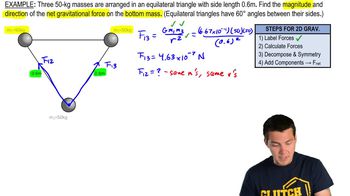
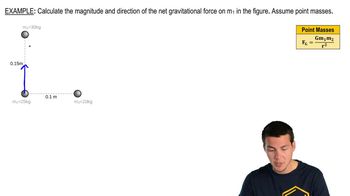
How do you calculate the net gravitational force on a mass due to two other masses in a two-dimensional arrangement?
To calculate the net gravitational force on a mass due to two other masses in 2D, determine the gravitational force vectors from each mass, decompose them into components, add the components vectorially, and use the Pythagorean theorem to find the magnitude.
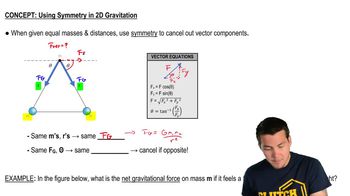
How can symmetry simplify the calculation of net gravitational force in a system of multiple masses?
Symmetry can simplify calculations by allowing you to identify and cancel out equal and opposite force components, reducing the number of calculations needed for the net force.
What is the general formula for the gravitational force between two point masses?
The gravitational force between two point masses is given by F = G * (m1 * m2) / r^2, where G is the gravitational constant, m1 and m2 are the masses, and r is the distance between their centers.