Heat Engines & PV Diagrams definitions Flashcards

Heat Engines & PV Diagrams definitions
Control buttons has been changed to "navigation" mode.
1/15
  • PV Diagram
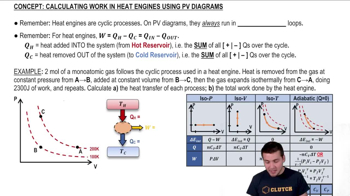
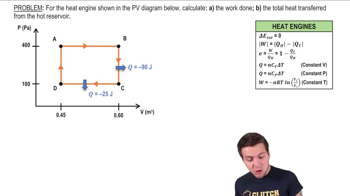
    A graphical representation of the pressure-volume relationship in thermodynamic processes.
  • Heat Engine
    A device that converts thermal energy into mechanical work through cyclic processes.
  • Cyclic Process
    A thermodynamic process that returns a system to its initial state, forming a closed loop on a PV diagram.
  • Isobaric Process
    A thermodynamic process occurring at constant pressure.
  • Isochoric Process
    A thermodynamic process occurring at constant volume, also known as isovolumetric.
  • Isothermal Process
    A thermodynamic process occurring at constant temperature.
  • Work
    The energy transferred by a system to its surroundings, often calculated as the area under a PV diagram curve.
  • Energy Flow Diagram
    A schematic showing the flow of energy in a system, highlighting heat input, work output, and waste heat.
  • Hot Reservoir
    The source of heat energy input into a heat engine.
  • Cold Reservoir
    The sink where waste heat is expelled from a heat engine.
  • Molar Specific Heat
    The amount of heat required to raise the temperature of one mole of a substance by one degree Celsius.
  • Monoatomic Gas
    A gas consisting of single atoms, often used in thermodynamic calculations.
  • Absolute Value
    The non-negative value of a number, used in calculations to ensure positive heat flow values.
  • Clockwise Loop
    The direction of a cycle on a PV diagram indicating a heat engine's operation.
  • Delta T
    The change in temperature, used in calculating heat transfer in thermodynamic processes.