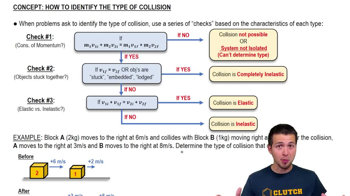
How can you identify the type of collision between two objects using their masses and velocities before and after the collision?
To identify the type of collision, follow these steps: (1) Check if momentum is conserved by verifying if the total initial momentum equals the total final momentum. (2) If momentum is conserved, check if the objects stick together after the collision (i.e., have the same final velocity); if so, it is a perfectly inelastic collision. (3) If they do not stick together, check if the sum of the initial and final velocities of one object equals that of the other; if so, it is an elastic collision. (4) If neither condition is met, the collision is inelastic.
What is the first step in determining the type of collision using a flowchart approach?
The first step is to check if the total initial momentum equals the total final momentum. If momentum is not conserved, the collision is not possible or the system is not isolated.
How can you tell from a problem statement if a collision is perfectly inelastic without calculating velocities?
Look for keywords such as 'stuck,' 'embedded,' or 'lodged' in the problem statement. These indicate the objects move together after the collision, signifying a perfectly inelastic collision.
What does it mean if the final velocities of both objects after a collision are not equal?
It means the objects did not stick together and the collision is not perfectly inelastic. You must then check for other types of collisions.
If the sum of the initial and final velocities of one object does not equal that of the other, what type of collision is it?
It is an inelastic collision. This is determined after ruling out perfectly inelastic and elastic collisions.
Why is it unnecessary to calculate the actual values of momentum or velocity when using the flowchart method?
You only need to check if the given values satisfy the required equations for each collision type. Plugging in the numbers directly is sufficient to determine the type.
What should you do if the initial and final total momenta are not equal in a collision problem?
You should conclude that the collision is not possible or the system is not isolated. No further checks for collision type are needed.
What is the significance of reaching the bottom of the collision flowchart without confirming a perfectly inelastic or elastic collision?
It means the collision is inelastic by default. This is because it does not meet the criteria for the other two types.
How does the flowchart approach help in solving collision problems with lots of given information?
It provides a systematic way to check each collision type using the provided data. This avoids unnecessary calculations and quickly identifies the collision type.
What is the role of conservation of momentum in identifying the type of collision?
Conservation of momentum is the foundational check to ensure the collision is physically possible. Only if momentum is conserved do you proceed to classify the collision type.