Skip to main content
Physics with Calculus
My Course
Learn
Exam Prep
AI Tutor
Study Guides
Textbook Solutions
Flashcards
Explore
Try the app
My Course
Learn
Exam Prep
AI Tutor
Study Guides
Textbook Solutions
Flashcards
Explore
Try the app
Back
How to Solve: Energy vs Torque definitions
You can tap to flip the card.
Newton's Laws
You can tap to flip the card.
👆
Newton's Laws
Fundamental principles describing motion, including F=ma, used to solve linear and rotational motion problems.
Track progress
Control buttons has been changed to "navigation" mode.
1/15
Related flashcards
Related practice
Recommended videos
How to Solve: Energy vs Torque quiz
How to Solve: Energy vs Torque
15 Terms
How to Solve: Energy vs Torque
14. Torque & Rotational Dynamics
5 problems
Topic
Torque Due to Weight
14. Torque & Rotational Dynamics
1 problem
Topic
David-Paige
14. Torque & Rotational Dynamics
6 topics
13 problems
Chapter
Patrick
Guided course
10:21
How to Solve:Energy vs Torque
6609
views
63
rank
2
comments
Terms in this set (15)
Hide definitions
Newton's Laws
Fundamental principles describing motion, including F=ma, used to solve linear and rotational motion problems.
Conservation of Energy
A principle stating that total energy remains constant in an isolated system, simplifying calculations in physics problems.
Linear Motion
Movement in a straight line, often analyzed using motion equations and Newton's laws.
Rotational Motion
Movement around an axis, analyzed using torque equations and conservation of energy.
Torque
A measure of rotational force, calculated as the product of force and lever arm distance.
Angular Acceleration
The rate of change of angular velocity, often denoted by alpha in rotational dynamics.
Angular Velocity
The rate of rotation around an axis, often denoted by omega, crucial in rotational motion analysis.
Kinematics Equations
Equations describing motion, used to calculate variables like velocity, acceleration, and displacement.
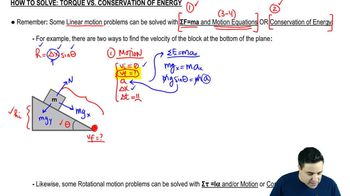
Frictionless Incline
An idealized surface with no friction, used to simplify calculations in physics problems.
Kinetic Energy
The energy of an object due to its motion, calculated as 1/2 mv^2 for linear motion.
Potential Energy
The energy stored in an object due to its position, often gravitational, calculated as mgh.
Motion Equations
Equations used to describe the motion of objects, including variables like time, velocity, and acceleration.
Yo-Yo
A toy used in physics examples to illustrate concepts of rotational motion and energy conservation.
Acceleration
The rate of change of velocity, a key variable in both linear and rotational motion problems.
Delta T
A symbol representing the change in time, often used in motion equations to solve for time-related variables.
 BackBack

 10:21
10:21