The Ideal Gas Law definitions Flashcards

The Ideal Gas Law definitions
Control buttons has been changed to "navigation" mode.
1/15
  • Ideal Gas
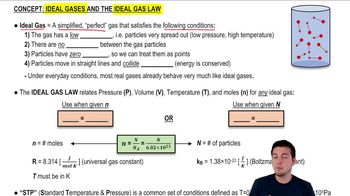
    A simplified model of a gas with low density, no intermolecular forces, zero particle size, and elastic collisions.
  • Ideal Gas Law
    An equation relating pressure, volume, temperature, and moles of an ideal gas: PV = nRT or PV = NkBT.
  • Universal Gas Constant
    A constant in the ideal gas law, denoted as R, with a value of 8.314 J/mol K.
  • Boltzmann's Constant
    A constant in the ideal gas law, denoted as kB, with a value of 1.38 x 10^-23 J/K.
  • Kelvin
    The temperature scale used in ideal gas law calculations, where 0 Kelvin is absolute zero.
  • STP
    Standard Temperature and Pressure, conditions of 0°C (273 K) and 1 atm pressure.
  • Molar Volume
    The volume occupied by one mole of an ideal gas at STP, approximately 22.4 liters.
  • Boyle's Law
    A special case of the ideal gas law where pressure is inversely proportional to volume at constant temperature.
  • Charles' Law
    A special case of the ideal gas law where volume is directly proportional to temperature at constant pressure.
  • Gay-Lussac's Law
    A special case of the ideal gas law where pressure is directly proportional to temperature at constant volume.
  • Elastic Collision
    A type of collision where total kinetic energy is conserved, typical in ideal gas particle interactions.
  • Avogadro's Number
    The number of particles in one mole, approximately 6.02 x 10^23.
  • Pressure
    The force exerted by gas particles per unit area on the walls of a container.
  • Volume
    The amount of space occupied by a gas, typically measured in liters or cubic meters.
  • Temperature
    A measure of the average kinetic energy of gas particles, affecting pressure and volume.