Control buttons has been changed to "navigation" mode.
1/10
Terms in this set (10)
During an isobaric (constant pressure) process for an ideal gas, how are the heat added to the system (q) and the work done by the gas (w) related?
In an isobaric process, the heat added to the system (q) is equal to the change in internal energy (ΔU) plus the work done by the gas (w). For an ideal gas, this is expressed as q = ΔU + w, where the work done at constant pressure is w = PΔV. The change in internal energy depends only on the temperature change, so q = nCpΔT, where Cp is the molar heat capacity at constant pressure.
What is the physical meaning of elastic collisions in the context of ideal gases?
Elastic collisions mean that when gas particles collide with each other or the container walls, no kinetic energy is lost. The total energy in the system remains constant during these collisions.
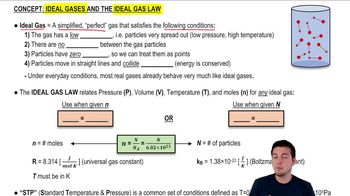
How are the number of moles and the number of particles in a gas related?
The number of moles (n) is equal to the number of particles (N) divided by Avogadro's number (6.02 x 10^23). This relationship allows conversion between moles and individual particles.
Why must temperature be measured in Kelvin when using the ideal gas law?
The ideal gas law requires absolute temperature to ensure proportionality between variables. Using Celsius or Fahrenheit would not provide correct results because they are not absolute temperature scales.
What is the value and unit of the universal gas constant R used in the ideal gas law?
The universal gas constant R has a value of 8.314 joules per mole Kelvin (J/mol·K). It is used in the equation PV = nRT.
What does STP stand for and what are its standard values for temperature and pressure?
STP stands for standard temperature and pressure, which are 273 Kelvin (0°C) and 1 atmosphere (1.01 x 10^5 Pascals). These conditions are commonly used as reference points in gas law problems.
How do you determine which version of the ideal gas law to use when given either moles or particles?
Use PV = nRT when given the number of moles and PV = NkBT when given the number of particles. The choice depends on whether the problem provides moles or individual particle count.
What is the molar volume of an ideal gas at STP and why is it significant?
The molar volume of an ideal gas at STP is 22.4 liters per mole. This value is significant because it applies to any ideal gas regardless of its chemical identity under those conditions.
How do you convert between cubic meters and liters when working with gas volumes?
One cubic meter is equal to 1,000 liters. This conversion is useful when the ideal gas law yields a volume in cubic meters but the answer is needed in liters.
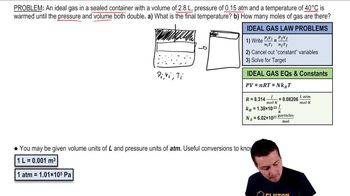
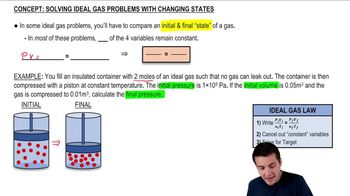
What is the general approach to solving problems where an ideal gas changes from one state to another?
Write the equation relating initial and final states, cancel out any constant variables, and solve for the unknown. This method ensures correct application of the ideal gas law to changing conditions.