How is the total impedance (Z) of a series AC circuit represented mathematically?
The total impedance (Z) of a series AC circuit is represented as the square root of the sum of the squares of the resistance and the reactance. For a series RC circuit, Z = sqrt(R^2 + X_C^2), where X_C is the capacitive reactance. For a series RL circuit, Z = sqrt(R^2 + X_L^2), where X_L is the inductive reactance.
What is the relationship between current phasors in a series AC circuit?
In a series AC circuit, all current phasors are in phase with each other. This is because the current is the same through all elements in series.
How do voltage phasors behave in a parallel AC circuit?
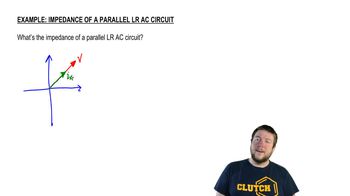
In a parallel AC circuit, all voltage phasors are in phase. This is due to the voltage being the same across all parallel elements.
Why can't you simply add the maximum voltages across a resistor and capacitor in a series RC circuit?
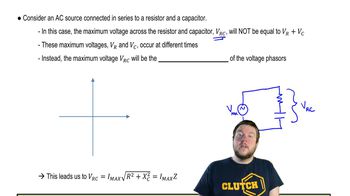
You can't simply add them because their maximum voltages do not occur at the same time. Instead, you must use the vector sum of their voltage phasors.
How is the total voltage across a resistor and capacitor in series calculated using phasors?
The total voltage is calculated as the square root of the sum of the squares of the individual voltages. This uses the Pythagorean theorem due to the 90-degree phase difference.
What is the phase relationship between the voltage across a resistor and its current in an AC circuit?
The voltage across a resistor is always in phase with its current. This means their peaks and zero crossings occur simultaneously.
How does the voltage across a capacitor relate to its current in terms of phase?
The voltage across a capacitor lags its current by 90 degrees. This means the voltage reaches its peak a quarter cycle after the current does.
What is the phase relationship between the voltage across an inductor and its current?
The voltage across an inductor leads its current by 90 degrees. This means the voltage reaches its peak a quarter cycle before the current does.
How is the impedance of a series RL circuit expressed in terms of angular frequency?
The impedance is given by the square root of the sum of the resistance squared and the square of the product of angular frequency and inductance. Mathematically, Z = sqrt(R^2 + (ωL)^2).
Why is impedance considered the effective reactance in an AC circuit?
Impedance combines the effects of resistance and reactance into a single quantity. It determines how the circuit resists the flow of alternating current, similar to resistance in DC circuits.