Impulse with Variable Forces definitions Flashcards
Impulse with Variable Forces definitions
You can tap to flip the card.
Control buttons has been changed to "navigation" mode.
1/15
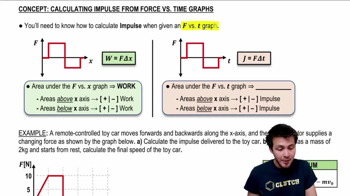
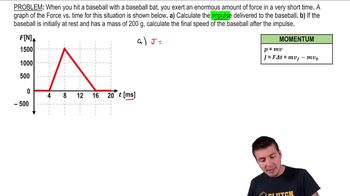
ImpulseThe change in momentum of an object, calculated as the area under a force vs. time graph.Force vs. Time GraphA graphical representation where the area under the curve indicates the impulse applied to an object.Positive ImpulseImpulse represented by the area above the X-axis on a force vs. time graph, indicating positive force.Negative ImpulseImpulse represented by the area below the X-axis on a force vs. time graph, indicating negative force.MomentumThe product of an object's mass and velocity, which changes due to impulse.Impulse-Momentum TheoremA principle stating that impulse is equal to the change in momentum of an object.Newton-secondsThe unit of impulse, equivalent to the change in momentum.Triangle AreaCalculated as 1/2 base times height, used to find impulse in force vs. time graphs.Rectangle AreaCalculated as base times height, used to find impulse in force vs. time graphs.TrapezoidA shape used to calculate areas under a curve in force vs. time graphs for impulse.Final VelocityThe speed of an object after an impulse has been applied, calculated using the impulse-momentum theorem.MassA measure of the amount of matter in an object, used in calculating momentum and impulse effects.BaseThe horizontal length of a geometric shape on a graph, used in area calculations for impulse.HeightThe vertical length of a geometric shape on a graph, used in area calculations for impulse.RestThe state of an object being stationary, often used as the initial condition in impulse problems.