Impulse with Variable Forces quiz #1 Flashcards

Impulse with Variable Forces quiz #1
Control buttons has been changed to "navigation" mode.
1/10
  • What is the general formula for impulse in terms of force and time?
    Impulse (J) is given by the integral of force over time: J = ∫ F dt. For a constant force, it simplifies to J = F × Δt.
  • How do you determine which collision has the largest impulse using force vs. time graphs?
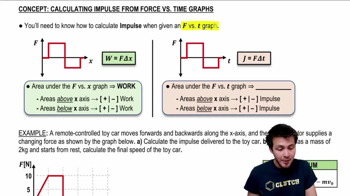
    The collision with the largest impulse is the one with the greatest area under the force vs. time graph, since impulse equals the area under the curve.
  • In a collision between two balls, what is the direction of the impulse applied to ball A by ball B?
    The direction of the impulse applied to ball A by ball B is the same as the direction of the force exerted by ball B on ball A during the collision.
  • How do you calculate the impulse on an object when given its mass and change in velocity?
    Impulse on an object is equal to its change in momentum: J = m(v_final - v_initial).
  • What is the impulse-momentum theorem?
    The impulse-momentum theorem states that the impulse applied to an object equals the change in its momentum: J = Δp = m(v_final - v_initial).
  • If a constant force acts on a ball for a certain time interval, how do you calculate the magnitude of the impulse on the ball?
    For a constant force, the magnitude of the impulse is J = F × Δt, where F is the force and Δt is the time interval.
  • What does the impulse experienced by a body represent in terms of its motion?
    The impulse experienced by a body is equivalent to the body's change in momentum.
  • How do you calculate the area of a triangle section under a force vs. time graph when determining impulse?
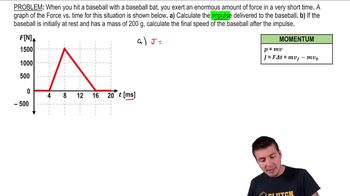
    You use the formula 1/2 × base × height, where the base is the time interval and the height is the force value. If the force is negative, include the negative sign in the calculation.
  • Why can't you use the formula J = F × Δt directly when the force is not constant in a force vs. time graph?
    The formula J = F × Δt assumes a constant force over the time interval, but if the force varies, you must sum the areas under the curve instead. This accounts for both positive and negative impulses as the force changes.
  • What happens to the impulse calculation if the area below the x-axis is greater than the area above it on a force vs. time graph?
    The total impulse will be negative, indicating that the net force acted in the negative direction over the time interval. This affects the direction of the object's change in momentum.