Inclined Planes with Friction quiz #1 Flashcards

Inclined Planes with Friction quiz #1
Control buttons has been changed to "navigation" mode.
1/10
  • How do you determine the friction force acting on a skier sliding down a 15° slope when friction is not negligible?
    To determine the friction force on a skier sliding down a 15° slope with friction, first identify whether the skier is moving or stationary. If the skier is moving, use kinetic friction: f_k = μ_k * N, where N = mg cos(15°). If the skier is stationary or just about to move, compare the downslope component of gravity (mg sin(15°)) to the maximum static friction (f_s,max = μ_s * N). If mg sin(15°) exceeds f_s,max, the skier moves and kinetic friction applies; otherwise, static friction equals mg sin(15°). The friction force always acts up the slope, opposing motion.
  • What is the direction of the friction force on a block placed on a rough inclined plane?
    The friction force always acts up the ramp, opposing the direction in which the block would slide. This is true whether the friction is static or kinetic.
  • How do you resolve the gravitational force acting on a block on an inclined plane?
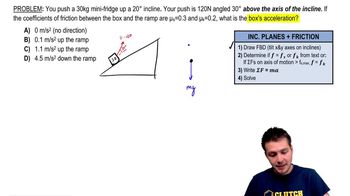
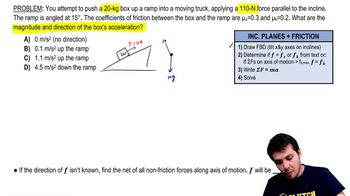
    The gravitational force is split into two components: one parallel to the ramp (mg sin θ) and one perpendicular to the ramp (mg cos θ). These components are used to analyze motion and forces along and normal to the surface.
  • What determines whether static or kinetic friction applies to a block on an inclined plane?
    You compare the downslope component of gravity (mg sin θ) to the maximum static friction (μ_s N). If mg sin θ exceeds μ_s N, the block moves and kinetic friction applies; otherwise, static friction is in effect.
  • How do you calculate the normal force on a block resting on an inclined plane?
    The normal force is given by N = mg cos θ, where θ is the angle of the incline. This force acts perpendicular to the surface of the ramp.
  • What is the significance of the critical angle in inclined plane problems with friction?
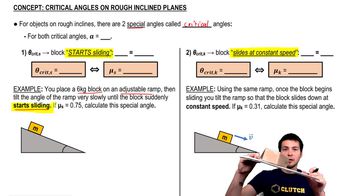
    The critical angle is the angle at which the block just begins to slide or slides at constant velocity. It is determined by the coefficients of static or kinetic friction, respectively.
  • How do you find the critical angle at which a block starts to slide on an inclined plane?
    Set mg sin θ equal to the maximum static friction (μ_s mg cos θ) and solve for θ. The critical angle is θ = arctan(μ_s).
  • What happens to the acceleration of a block at the critical angle where it just starts to slide?
    At the critical angle, the acceleration is zero because the forces are balanced. This represents the threshold where motion is about to begin.
  • How do you determine the angle at which a block slides down an incline at constant velocity?
    Set mg sin θ equal to kinetic friction (μ_k mg cos θ) and solve for θ. The angle is θ = arctan(μ_k).
  • Why does the mass of the block not affect the critical angles for sliding on an inclined plane?
    The mass cancels out when setting up the force balance equations for critical angles. Therefore, the critical angles depend only on the coefficients of friction, not on mass.