Inductors quiz #1 Flashcards

Inductors quiz #1
Control buttons has been changed to "navigation" mode.
1/10
  • What is the inductance of a closely packed coil, and how does it affect the circuit when the current is changing?
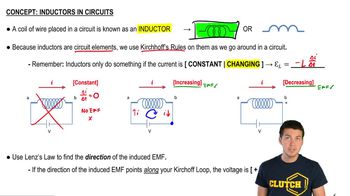
    The inductance of a closely packed coil, denoted by 'L', is a measure of the coil's ability to oppose changes in current by inducing an EMF (electromotive force) in itself. When the current through the coil is changing, the self-induced EMF is given by EMF = -L * (change in current/change in time). This induced EMF opposes the change in current, as described by Lenz's Law, and only affects the circuit when the current is not constant.
  • What are the two common circuit symbols used to represent an inductor?
    The two common symbols are a series of bumps (zigzag) and a series of loops (coiled line). Both represent the same component in circuit diagrams.
  • When does an inductor have no effect on a circuit according to the video?
    An inductor has no effect when the current through it is constant. This is because the change in current over time is zero, resulting in zero induced EMF.
  • How does Lenz's Law determine the direction of the induced EMF in an inductor?
    Lenz's Law states that the induced EMF always opposes the change in current that created it. This opposition is represented by the negative sign in the EMF formula.
  • What happens to the direction of the induced EMF if the current through an inductor is increasing?
    If the current is increasing, the induced EMF acts in the direction opposite to the current's increase. This opposes the strengthening magnetic field.
  • How does the induced EMF behave if the current through an inductor is decreasing?
    If the current is decreasing, the induced EMF acts to reinforce the weakening magnetic field. It points in the same direction as the original current.
  • In applying Kirchhoff's loop rule, how do you determine the sign of the voltage across an inductor?
    The sign depends on whether the direction of the induced EMF aligns with the direction of the loop. If they align, the voltage is positive; if they oppose, it is negative.
  • What is the general form of Kirchhoff's loop rule for a circuit containing a battery, inductor, and resistor?
    The general form is: battery voltage minus the inductor's EMF minus the resistor's voltage equals zero. Mathematically, this is written as V_b - L*(ΔI/Δt) - I*R = 0.
  • Why is it important to know both the magnitude and direction of the induced EMF when analyzing circuits with inductors?
    Both magnitude and direction are needed to correctly apply Kirchhoff's rules and determine voltage signs. This ensures accurate analysis of circuit behavior.
  • What role does the direction of your chosen loop play in determining voltage signs in Kirchhoff's loop rule?
    The loop direction determines whether you add or subtract each voltage as you traverse the circuit. It affects the sign of each term in the loop equation.