Skip to main content
Physics with Calculus
My Course
Learn
Exam Prep
AI Tutor
Study Guides
Textbook Solutions
Flashcards
Explore
Try the app
My Course
Learn
Exam Prep
AI Tutor
Study Guides
Textbook Solutions
Flashcards
Explore
Try the app
Back
Inertial Reference Frames definitions
You can tap to flip the card.
Inertial Reference Frame
You can tap to flip the card.
👆
Inertial Reference Frame
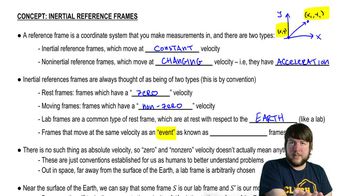
A coordinate system moving at a constant velocity, either at rest or in uniform motion.
Track progress
Control buttons has been changed to "navigation" mode.
1/15
Related flashcards
Related practice
Recommended videos
Inertial Reference Frames quiz
Inertial Reference Frames
10 Terms
Inertial Reference Frames quiz #1
Inertial Reference Frames
10 Terms
Inertial Reference Frames
36. Special Relativity
7 problems
Topic
Patrick
Special Vs. Galilean Relativity
36. Special Relativity
4 problems
Topic
Patrick
35. Special Relativity
4 topics
10 problems
Chapter
Patrick
Guided course
14:10
Inertial Reference Frames
4261
views
45
rank
7
comments
Terms in this set (15)
Hide definitions
Inertial Reference Frame
A coordinate system moving at a constant velocity, either at rest or in uniform motion.
Non-Inertial Frame
A reference frame experiencing acceleration, not covered by special relativity.
Lab Frame
A rest frame typically stationary relative to the Earth's surface, used for experiments.
Moving Frame
A reference frame in motion relative to the lab frame, used to analyze moving objects.
Proper Frame
A frame moving at the same velocity as an event, often used in relativity discussions.
Velocity
The speed and direction of an object or frame, denoted as 'u' for frames and 'V' for objects.
Special Relativity
A theory focusing on inertial frames, ignoring non-inertial frames, developed by Einstein.
General Relativity
Einstein's theory addressing non-inertial frames and gravitational effects.
Coriolis Force
A force due to Earth's rotation, affecting weather patterns like hurricane rotation.
Centrifugal Force
An apparent force altering gravitational acceleration due to Earth's rotation.
Cartesian Coordinate System
A system using horizontal and vertical axes to measure positions in a reference frame.
Event
An occurrence or phenomenon, such as a decaying particle, analyzed in relativity.
Ticking Clock
A common event in relativity, representing time passage in different frames.
Rest Frame
A frame with zero velocity relative to a chosen reference point, like the Earth's surface.
Acceleration
A change in velocity, characteristic of non-inertial frames.
 BackBack
 14:10
14:10