How do linear momentum and angular momentum differ in terms of their definitions, units, and dependence on reference points?
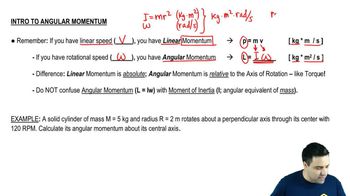
Linear momentum (p) is defined as mass times velocity (p = mv) and has units of kg·m/s. It is absolute and does not depend on the reference point. Angular momentum (L) is defined as moment of inertia times angular velocity (L = Iω) and has units of kg·m²/s. It is relative and depends on the axis of rotation.
Which physical quantities contribute to the angular momentum of a spinning object?
The angular momentum of a spinning object depends on its moment of inertia (which is determined by mass and its distribution relative to the axis of rotation) and its angular velocity.
How do you calculate the angular momentum of an object that is rotating?
To calculate the angular momentum (L) of a rotating object, use the formula L = Iω, where I is the moment of inertia and ω is the angular velocity.
How can you determine which of two turbines rotates through 1.0 radian of angular displacement in less time?
To determine which turbine takes less time to rotate through 1.0 radian, compare their angular velocities (ω). The time required is t = θ/ω, where θ is the angular displacement (1.0 radian). The turbine with the greater angular velocity will take less time.
What is the angular equivalent of mass used in the calculation of angular momentum?
The angular equivalent of mass is the moment of inertia, denoted as I. It reflects how mass is distributed relative to the axis of rotation.
How do you convert an object's rotational speed from RPM to angular velocity in radians per second?
To convert RPM to angular velocity ω, use the formula ω = 2π × (RPM/60). This gives ω in radians per second.
Why can the unit 'radian' be omitted when expressing the units of angular momentum?
A radian is a ratio of two lengths (meters/meters), so it is dimensionless. Therefore, the units of angular momentum simplify to kg·m²/s.
If a solid cylinder rotates about its central axis, which formula should be used for its moment of inertia?
For a solid cylinder rotating about its central axis, use I = (1/2)MR². Here, M is the mass and R is the radius of the cylinder.
What must you do before calculating angular momentum if you are given rotational speed in RPM?
You must first convert the RPM value to angular velocity in radians per second. This ensures the units are consistent for the L = Iω formula.
How does the axis of rotation affect the value of angular momentum for a rotating object?
The value of angular momentum depends on the chosen axis of rotation. Changing the axis can change the moment of inertia and thus the angular momentum.
 Back
Back

 06:18
06:18