How do you calculate the work required to pull a sled a certain distance using a constant force, and what is the work done if a 60 N force is used to pull a sled 5 meters in the direction of the force?
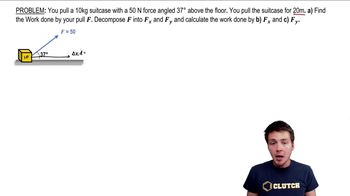
Work is calculated using the formula W = Fd cos(θ), where F is the force applied, d is the displacement, and θ is the angle between the force and displacement. If the force and displacement are in the same direction (θ = 0°), cos(0) = 1, so W = F × d. For a 60 N force pulling a sled 5 meters in the same direction, the work done is W = 60 N × 5 m = 300 joules.
What is the physical meaning of work in the context of energy transfer between objects?
Work represents the amount of energy transferred from one object to another by a force. It quantifies how much energy a force gives to or takes from an object.
How does the angle between the force and displacement vectors affect the calculation of work?
The angle determines the cosine factor in the work formula, W = Fd cos(θ). If the vectors are parallel (θ = 0°), cos(θ) = 1, and if they are antiparallel (θ = 180°), cos(θ) = -1.
What happens to the kinetic energy of a box at rest when you push it on a frictionless surface?
The box gains kinetic energy as it starts moving due to the applied force. This increase in kinetic energy comes from the work done by you on the box.
When is the work done by a force considered negative, and what does this signify physically?
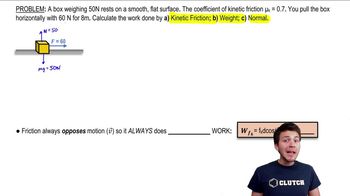
Work is negative when the force acts opposite to the direction of displacement. This means the force is taking energy away from the object, reducing its kinetic energy.
How do you determine the sign of work done by gravity when an object is falling versus when it is rising?
Gravity does positive work when the object falls because force and displacement are in the same direction. It does negative work when the object rises since force and displacement are in opposite directions.
What is the formula for the work done by gravity when an object moves vertically, and what variables does it depend on?
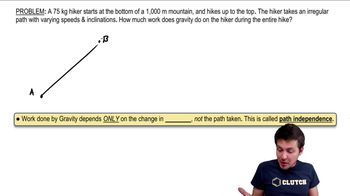
The work done by gravity is W = mgΔy, where m is mass, g is gravitational acceleration, and Δy is the vertical displacement. The sign depends on whether the object moves with or against gravity.
Why does the kinetic energy of a falling object just before it hits the ground equal the work done by gravity?
Because all the work done by gravity is converted into kinetic energy as the object falls. This demonstrates the conservation of energy principle.
In the case of a rock thrown upward, why does its kinetic energy become zero at the maximum height?
As the rock rises, gravity does negative work, removing kinetic energy until none remains at the peak. At maximum height, all initial kinetic energy has been used to work against gravity.
What is the relationship between the direction of force, displacement, and the sign of work in determining energy transfer?
If force and displacement are in the same direction, work is positive and energy is added to the object. If they are in opposite directions, work is negative and energy is removed from the object.