Pearson+ LogoPearson+ Logo

Intro to Conservation of Momentum quiz #1 Flashcards

Back
Intro to Conservation of Momentum quiz #1
Control buttons has been changed to "navigation" mode.
1/14
  • How do you determine the total momentum of a system after a collision?

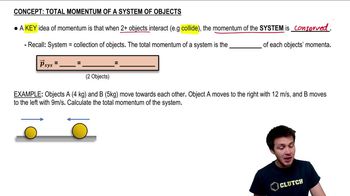
    The total momentum of a system after a collision is found by vector summing the momenta of all objects in the system after the collision, using the formula P_system = m1v1_final + m2v2_final, where m and v represent the mass and final velocity of each object.
  • What is the total momentum of a system after a collision according to the law of conservation of momentum?

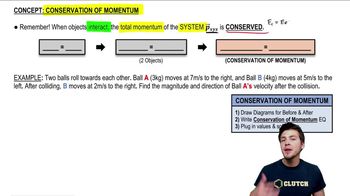
    According to the law of conservation of momentum, the total momentum of a system after a collision is equal to the total momentum of the system before the collision, provided the system is closed and no external forces act on it.
  • What condition must be met for the momentum of a system to be conserved?

    For the momentum of a system to be conserved, the system must be closed, meaning no external forces act on it.
  • How do you calculate the momentum of a system after two football players collide?

    After two football players collide, the momentum of the system is the vector sum of their individual momenta after the collision: P_system = m1v1_final + m2v2_final, where m and v are the mass and final velocity of each player.
  • After a gun is fired, which object has more momentum: the bullet or the gun?

    After firing, the bullet and the gun have equal magnitudes of momentum but in opposite directions, so neither has more momentum; their momenta are equal and opposite to conserve the total momentum of the system.
  • Under what conditions is momentum conserved in a collision?

    Momentum is conserved in a collision if the system is closed and no external forces act on it.
  • What quantity is conserved when two objects collide in a closed system?

    The total momentum of the system is conserved when two objects collide in a closed system.
  • What is the equation that best describes the law of conservation of momentum for two objects?

    The law of conservation of momentum for two objects is described by: m1v1_initial + m2v2_initial = m1v1_final + m2v2_final.
  • What is true about the total momentum of a closed system?

    The total momentum of a closed system remains constant; it does not change over time.
  • What must the total momentum of a system be after two train cars collide in a closed system?

    After two train cars collide in a closed system, the total momentum of the system must be equal to the total momentum before the collision.
  • To which fundamental principle is the conservation of momentum most closely related?

    The conservation of momentum is most closely related to the principle that the total momentum of a closed system remains constant if no external forces act on it.
  • What does the law of conservation of momentum state in physics?

    The law of conservation of momentum states that the total momentum of a system of interacting objects remains constant; the total initial momentum equals the total final momentum, provided no external forces act on the system.
  • Under what conditions is momentum conserved in a system of objects?

    Momentum is conserved in a system when no external forces act on the system; that is, the total momentum before interaction equals the total momentum after interaction.
  • How do you determine if the total momentum of a system is conserved?

    The total momentum of a system is conserved if the vector sum of the momenta of all objects before an interaction equals the vector sum after the interaction, assuming no external forces are present. This is expressed as P_system_initial = P_system_final.