Skip to main content
Physics with Calculus
My Course
Learn
Exam Prep
AI Tutor
Study Guides
Textbook Solutions
Flashcards
Explore
Try the app
My Course
Learn
Exam Prep
AI Tutor
Study Guides
Textbook Solutions
Flashcards
Explore
Try the app
Back
Intro to Current definitions
You can tap to flip the card.
Electrodynamics
You can tap to flip the card.
👆
Electrodynamics
Study of electric charges in motion, as opposed to electrostatics where charges are stationary.
Track progress
Control buttons has been changed to "navigation" mode.
1/12
Related flashcards
Related practice
Recommended videos
Intro to Current quiz
Intro to Current
11 Terms
Intro to Current quiz #1
Intro to Current
40 Terms
Intro to Current
27. Resistors & DC Circuits
7 problems
Topic
Patrick
Current with Calculus
27. Resistors & DC Circuits
5 problems
Topic
27. Resistors & DC Circuits - Part 1 of 2
4 topics
12 problems
Chapter
Patrick
27. Resistors & DC Circuits - Part 2 of 2
5 topics
14 problems
Chapter
Patrick
Guided course
05:38
Intro to Current
15855
views
373
rank
5
comments
Terms in this set (12)
Hide definitions
Electrodynamics
Study of electric charges in motion, as opposed to electrostatics where charges are stationary.
Current
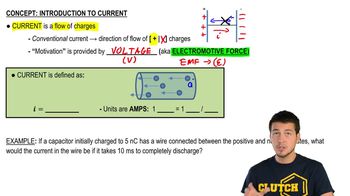
Flow of electric charge, typically measured in amperes, representing charge passing through a point per unit time.
Conventional Current
Direction of current flow assumed to be positive charges, opposite to the actual electron flow.
Potential Difference
Voltage between two points that motivates charge movement, also known as electromotive force.
Electromotive Force
Another term for potential difference, not an actual force, but drives electron movement.
Amperes
Unit of electric current, equivalent to one coulomb of charge passing a point per second.
Capacitor
Device that stores electrical energy in an electric field, used in the example to calculate current.
Nano Coulombs
Unit of electric charge, equal to 10^-9 coulombs, used in the example calculation.
Milliamp
One thousandth of an ampere, used to measure small currents in the example.
Elementary Charge
Fundamental charge unit, approximately 1.6 x 10^-19 coulombs, used to calculate electron numbers.
Cross-sectional Area
Area through which charge flows, used to define current as charge per time.
Electron Flow
Actual movement of electrons, opposite to the direction of conventional current.
 BackBack
 05:38
05:38