Calculating Dot Product Using Components quiz #1 Flashcards

Calculating Dot Product Using Components quiz #1
Control buttons has been changed to "navigation" mode.
1/10
  • How do you identify the y-component of a vector when it is expressed in terms of its components using unit vectors i, j, and k?
    The y-component of a vector expressed in terms of unit vectors is the coefficient of the j unit vector. For example, in the vector F = Fx i + Fy j + Fz k, the y-component is Fy.
  • What is the general formula for the dot product of two vectors expressed in terms of their i, j, and k components?
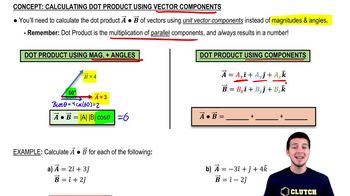
    The general formula is Ax * Bx + Ay * By + Az * Bz, where A and B are the vectors and x, y, z are their respective components. This formula sums the products of corresponding components.
  • How do you handle the dot product calculation if one vector is two-dimensional and the other is three-dimensional?
    You treat the missing component in the two-dimensional vector as zero. This means any term involving the missing component will be zero and can be omitted from the sum.
  • What type of result do you obtain when calculating the dot product of two vectors using their components?
    The result is always a scalar, which is a single number. This scalar is the sum of the products of the parallel components.
  • When calculating the dot product using components, what should you be careful about regarding the signs of the components?
    You must keep track of the signs of each component during multiplication. Incorrectly handling negative signs can lead to the wrong result.
  • If you have vectors A = 2i + 3j and B = i + 2j, what is the process to find their dot product?
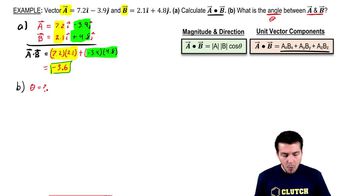
    Multiply the i components together and the j components together, then add the results. Specifically, calculate 2*1 + 3*2 to get the dot product.
  • Why does the k component sometimes not contribute to the dot product in certain calculations?
    If one of the vectors lacks a k component, it is treated as zero. Multiplying by zero means the k term does not contribute to the sum.
  • What does the dot product physically represent when calculated using vector components?
    It represents the sum of the products of the parallel components of the two vectors. This is equivalent to projecting one vector onto another and multiplying their magnitudes in that direction.
  • In the context of dot product, what does 'multiplying parallel components' mean?
    It means multiplying the corresponding i, j, and k components of the two vectors. Only these matching components are multiplied and then summed.
  • When should you use the component formula for the dot product instead of the magnitude and angle formula?
    Use the component formula when you are given the vectors in terms of their i, j, and k components rather than their magnitudes and the angle between them. This method is especially useful when diagrams or direct component values are provided.