Skip to main content
Physics with Calculus
My Course
Learn
Exam Prep
AI Tutor
Study Guides
Textbook Solutions
Flashcards
Explore
Try the app
My Course
Learn
Exam Prep
AI Tutor
Study Guides
Textbook Solutions
Flashcards
Explore
Try the app
Back
Intro to Energy Types quiz
1 student found this helpful
You can tap to flip the card.
Which of the following is not a form of energy: mechanical energy, thermal energy, sound energy, or friction?
You can tap to flip the card.
👆
Which of the following is not a form of energy: mechanical energy, thermal energy, sound energy, or friction?
Friction is not a form of energy. It is a force that can convert mechanical energy into thermal energy.
Track progress
Control buttons has been changed to "navigation" mode.
1/10
Related flashcards
Related practice
Recommended videos
Intro to Energy Types definitions
Intro to Energy Types
15 Terms
Intro to Energy Types quiz #1
Intro to Energy Types
12 Terms
Intro to Energy Types
10. Conservation of Energy
7 problems
Topic
Emilee
Gravitational Potential Energy
10. Conservation of Energy
5 problems
Topic
Jonathan
10. Conservation of Energy - Part 1 of 2
7 topics
15 problems
Chapter
Patrick
10. Conservation of Energy - Part 2 of 2
4 topics
11 problems
Chapter
Guided course
03:26
Intro to Energy Types
8153
views
231
rank
Terms in this set (10)
Hide definitions
Which of the following is not a form of energy: mechanical energy, thermal energy, sound energy, or friction?
Friction is not a form of energy. It is a force that can convert mechanical energy into thermal energy.
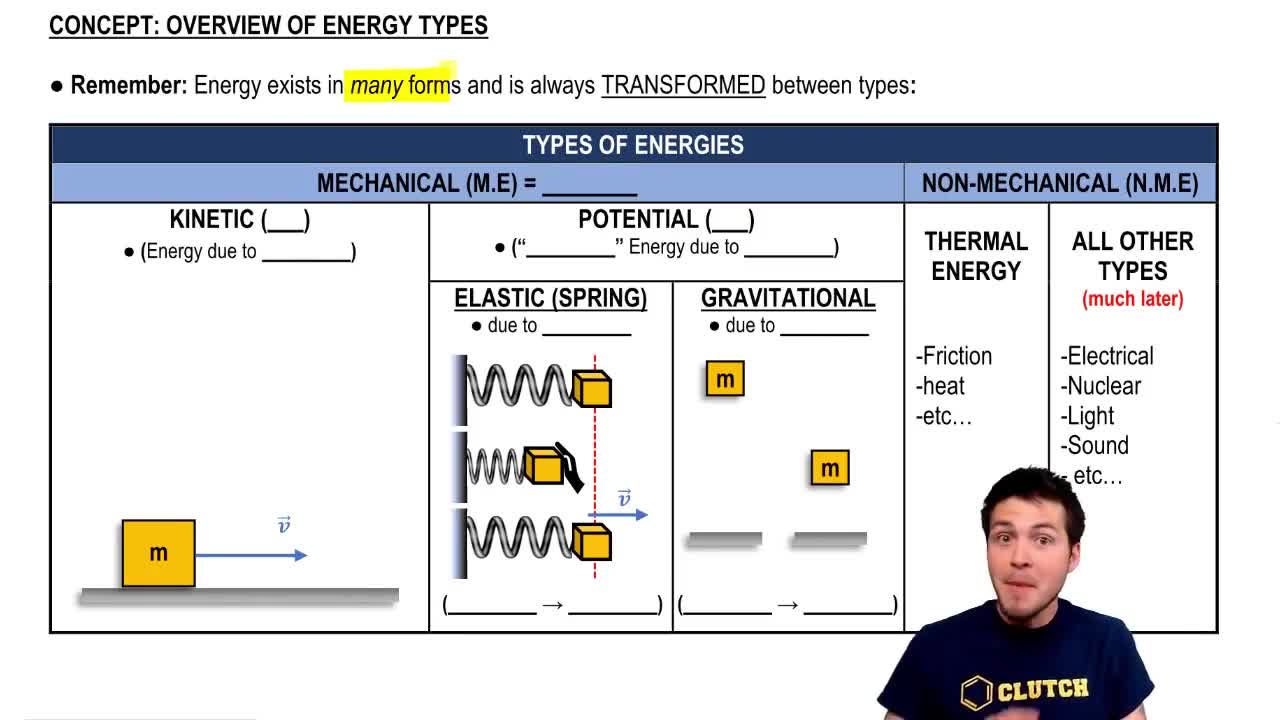
What are the two main subcategories of energy?
The two main subcategories of energy are mechanical energy and non-mechanical energy.
What is kinetic energy?
Kinetic energy is the energy due to an object's speed or motion.
What are the two types of potential energy?
The two types of potential energy are elastic potential energy and gravitational potential energy.
How is elastic potential energy stored?
Elastic potential energy is stored due to a spring's deformation, either by compressing or stretching it.
What causes gravitational potential energy?
Gravitational potential energy is caused by an object's height above the ground.
How does friction relate to energy?
Friction is a force that can convert mechanical energy into thermal energy.
What happens to energy when a spring is released?
When a spring is released, the stored elastic potential energy is converted into kinetic energy.
How does lifting an object affect its energy?
Lifting an object increases its gravitational potential energy, which can be converted to kinetic energy as it falls.
What is a common characteristic of potential energy?
A common characteristic of potential energy is that it is stored energy due to an object's position.
 BackBack


 03:26
03:26