Intro to Impulse quiz #1 Flashcards

Intro to Impulse quiz #1
Control buttons has been changed to "navigation" mode.
1/10
  • In a graph of force versus time, what represents the impulse delivered by the force?
    The impulse delivered by the force is represented by the area under the force versus time graph.
  • How do airbags in vehicles affect impulse and momentum during a collision?
    Airbags increase the time over which the collision force acts, reducing the force experienced by occupants for the same change in momentum (impulse), thereby making collisions safer.
  • What is the relationship between impulse and momentum?
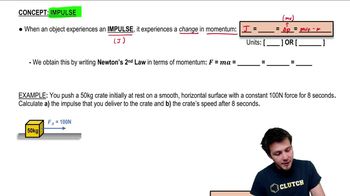
    Impulse is equal to the change in momentum of an object; mathematically, J = Δp = F × Δt.
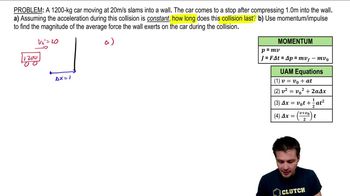
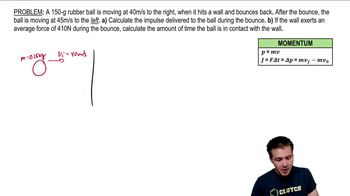
  • How can you calculate the magnitude of the impulse delivered by a wall to an object during a collision?
    The magnitude of the impulse delivered by the wall is equal to the change in the object's momentum, J = m(v_final - v_initial), or equivalently, the force exerted by the wall multiplied by the duration of contact, J = F × Δt.
  • If an object receives an impulse, what can be said about its momentum?
    If an object receives an impulse, its momentum changes by an amount equal to the impulse.
  • What value of maximum force (F_max) applied over a given time interval Δt will result in an impulse of 9.6 N·s?
    The value of F_max required is F_max = 9.6 N·s / Δt, where Δt is the duration of force application.
  • How is impulse accurately described in physics?
    Impulse is the product of force and the time interval over which it acts, and it equals the change in momentum of an object.
  • How do you calculate the impulse exerted by a force on a 250 g particle over a time interval?
    Impulse is calculated as J = F × Δt, where F is the force applied and Δt is the time interval. For a 250 g (0.25 kg) particle, the impulse changes its momentum by J = m(v_final - v_initial).
  • How does impulse compare to the change in momentum of an object?
    Impulse is exactly equal to the change in momentum of an object.
  • What value of maximum force (F_max) applied over a given time interval Δt will result in an impulse of 6.0 N·s?
    The value of F_max required is F_max = 6.0 N·s / Δt, where Δt is the duration of force application.