Refrigerators definitions Flashcards

Refrigerators definitions
Control buttons has been changed to "navigation" mode.
1/15
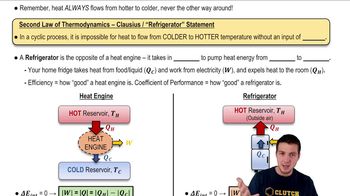
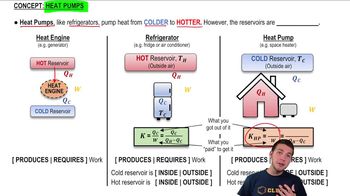
  • Refrigerator
    A device that transfers heat from a cold reservoir to a hot reservoir using work input.
  • Heat Engine
    A system that converts heat energy into work by taking heat from a hot reservoir and expelling waste heat to a cold reservoir.
  • Second Law of Thermodynamics
    A principle stating that heat cannot spontaneously flow from a colder body to a hotter body without work input.
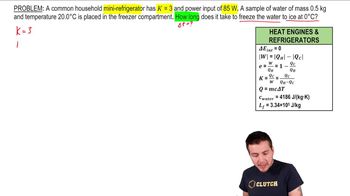
  • Coefficient of Performance (COP)
    A measure of a refrigerator's efficiency, calculated as the heat removed from the cold reservoir divided by the work input.
  • Cyclic Process
    A process in which a system returns to its initial state, resulting in no change in internal energy.
  • Cold Reservoir
    The part of a refrigerator or heat pump from which heat is extracted.
  • Hot Reservoir
    The part of a refrigerator or heat pump to which heat is expelled.
  • Work
    The energy required to transfer heat from a cold reservoir to a hot reservoir in a refrigerator.
  • Heat Pump
    A device similar to a refrigerator that transfers heat from a cold outside environment to a warmer interior space.
  • Clausius Statement
    A formulation of the second law of thermodynamics stating that heat cannot flow from cold to hot without work.
  • Efficiency
    A measure of how well a heat engine converts heat into work, expressed as the ratio of work output to heat input.
  • Power
    The rate at which work is done or energy is transferred, measured in watts.
  • Joule
    A unit of energy or work in the International System of Units, equivalent to one watt-second.
  • Kilojoule
    A unit of energy equal to 1,000 joules, often used to express energy quantities in thermodynamics.
  • Energy Flow Diagram
    A visual representation of the energy transfers and transformations in a system, such as a refrigerator or heat pump.