Intro to Moment of Inertia quiz #1 Flashcards

Intro to Moment of Inertia quiz #1
Control buttons has been changed to "navigation" mode.
1/10
  • On which physical properties does the moment of inertia of an object depend?
    The moment of inertia of an object depends on both its mass and the distribution of that mass relative to the axis of rotation (specifically, the distance of each mass element from the axis).
  • How do you calculate the moment of inertia of a point particle about a given axis?
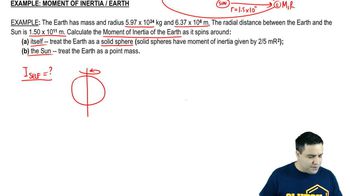
    The moment of inertia (I) of a point particle about a given axis is calculated using the formula I = M R^2, where M is the mass of the particle and R is its distance from the axis of rotation.
  • What is the general formula for the moment of inertia of a point mass?
    The general formula for the moment of inertia of a point mass is I = M R^2, where M is the mass and R is the distance from the axis of rotation.
  • How is the moment of inertia of a door calculated for rotation about its hinges?
    The moment of inertia of a door for rotation about its hinges is determined by considering the door as a rigid body and using the appropriate formula for its geometry and axis of rotation, typically found in tables. For a rectangular door rotating about one edge, the formula is I = (1/3) M L^2, where M is the mass and L is the width of the door.
  • How do you find the moment of inertia of a system of point masses about an axis passing through two of the masses?
    To find the moment of inertia about an axis passing through two point masses, sum the moments of inertia of all masses, using I = Σ M_i R_i^2, where M_i is the mass of each particle and R_i is its distance from the axis. For masses on the axis, R_i = 0, so their contribution is zero.
  • What is the general method to determine the moment of inertia of a shaded area (or any rigid body) about the x-axis?
    To determine the moment of inertia of a shaded area (or rigid body) about the x-axis, integrate the mass elements multiplied by the square of their perpendicular distance to the x-axis: I_x = ∫ y^2 dm, where y is the distance from the x-axis and dm is the mass element. For standard shapes, use the formula provided in tables.
  • What does a higher moment of inertia indicate about an object's resistance to changes in rotational motion?
    A higher moment of inertia means the object has greater resistance to changes in its rotational velocity. This makes it harder to start or stop the object's rotation.
  • How does the moment of inertia formula for a rigid body generally differ from that of a point mass?
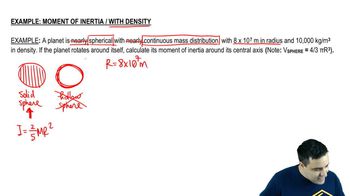
    For a rigid body, the moment of inertia formula typically includes a fractional coefficient multiplied by the mass and the square of a characteristic length. In contrast, for a point mass, it is simply the mass times the square of the distance from the axis.
  • Why does a massless rod contribute nothing to the total moment of inertia in a system of point masses?
    A massless rod has zero mass, so its moment of inertia is zero regardless of its length or axis of rotation. Only objects with mass contribute to the system's total moment of inertia.
  • What are the SI units for moment of inertia and how are they derived?
    The SI units for moment of inertia are kilogram meter squared (kg·m²). They are derived from multiplying mass in kilograms by the square of the distance in meters.