Pearson+ LogoPearson+ Logo

Kepler's Third Law quiz #1 Flashcards

Kepler's Third Law quiz #1
Control buttons has been changed to "navigation" mode.
1/10
  • According to Kepler's Third Law, which planet in the solar system takes the longest time to orbit the Sun?

    The planet that is farthest from the Sun has the longest orbital period, because the orbital period increases with the cube of the semi-major axis (distance from the Sun).
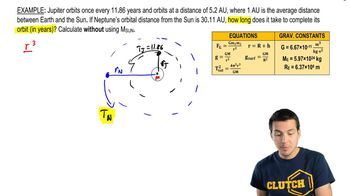
  • Using Kepler's Third Law, what is the orbital period in Earth years of a planet whose average distance from the Sun is 3 astronomical units (AU)?

    By Kepler's Third Law, T^2 = a^3, so T = sqrt(3^3) = sqrt(27) ≈ 5.2 Earth years.
  • What is the semi-major axis in astronomical units (AU) of a planet with an orbital period of 75 years around the Sun?

    Using Kepler's Third Law, a^3 = T^2, so a = (T^2)^{1/3} = (75^2)^{1/3} = (5625)^{1/3} ≈ 17.8 AU.
  • What is the orbital period in Earth years of a planet whose average distance from the Sun is 3 AU?

    By Kepler's Third Law, T = sqrt(a^3) = sqrt(27) ≈ 5.2 Earth years.
  • What is the orbital period in years of a planet with a semi-major axis of 35 AU?

    Using Kepler's Third Law, T = sqrt(a^3) = sqrt(35^3) = sqrt(42875) ≈ 207 years.
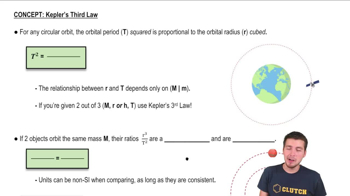
  • What does Kepler's Third Law (T^2 ∝ a^3) state about the relationship between a planet's orbital period and its distance from the Sun?

    Kepler's Third Law states that the square of a planet's orbital period is proportional to the cube of its average distance (semi-major axis) from the Sun.
  • Which statement follows directly from Kepler's Third Law (T^2 ∝ a^3) for planets orbiting the same star?

    For any two planets orbiting the same star, the ratio a^3/T^2 is the same for both planets.
  • If a planet orbits a star and completes one orbit in one year, what can be inferred about its average distance from the star according to Kepler's Third Law?

    If a planet's orbital period is one year, its average distance from the star (semi-major axis) is 1 AU, assuming the star's mass is similar to the Sun.
  • Why is it necessary to convert all measurements to SI units when calculating the mass of the Sun using Kepler's Third Law?

    SI units ensure consistency and accuracy in calculations involving physical constants like G. Using non-SI units can lead to incorrect results unless all quantities are properly converted.
  • What does Kepler's Third Law reveal about the dependence of a satellite's orbital period on its own mass?

    Kepler's Third Law shows that the orbital period depends only on the mass of the central body being orbited, not the mass of the satellite. This means the satellite's own mass does not affect its orbital period.