Control buttons has been changed to "navigation" mode.
1/10
Terms in this set (10)
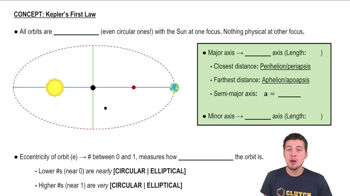
What is the shape of Earth's orbit according to Kepler's First Law?
Earth's orbit is an ellipse, with the sun at one of the foci. However, Earth's orbit is nearly circular because its eccentricity is very close to zero.
Which objects in the solar system have the most elliptical and tilted orbits?
Comets in the solar system have the most elliptical orbits, with high eccentricity values close to 1, making their paths highly elongated compared to planets, which have nearly circular orbits.
What is the total length of the major axis in an elliptical orbit in terms of the semi-major axis 'a'?
The total length of the major axis is 2a. This is because each half of the major axis is of length 'a'.
What are the names given to the closest and farthest points in an orbit around the sun?
The closest point is called the periapsis or perihelion, and the farthest point is called the apoapsis or aphelion. These terms describe the minimum and maximum distances from the sun, respectively.
How is the semi-major axis 'a' calculated using the distances at periapsis (RP) and apoapsis (RA)?
The semi-major axis 'a' is calculated as (RA + RP)/2. This formula gives the average of the closest and farthest distances from the sun.
What is the length of the minor axis in terms of the variable 'b'?
The length of the minor axis is 2b. Each half of the minor axis has a length of 'b'.
What does an eccentricity value close to zero indicate about an orbit's shape?
An eccentricity close to zero indicates the orbit is nearly circular. This is typical for most planets in our solar system.
What is the formula for the distance at apoapsis (RA) in terms of the semi-major axis and eccentricity?
The formula is RA = a(1 + e). This relates the farthest distance to the semi-major axis and the orbit's eccentricity.
If the eccentricity of an orbit is exactly zero, what can be said about the distances at periapsis and apoapsis?
If eccentricity is zero, both periapsis and apoapsis distances equal the semi-major axis 'a'. This means the orbit is a perfect circle.
Why can you often ignore the exponents when dividing two astronomical distances with the same exponent?
You can ignore the exponents because they cancel out during division. This simplifies calculations when the numbers share the same power of ten.