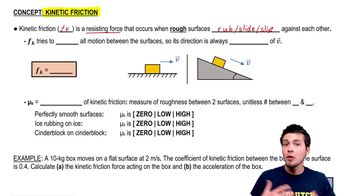
What is the difference between static friction and kinetic friction?
Static friction resists the initiation of motion between two surfaces at rest, while kinetic friction resists the relative motion of two surfaces that are already sliding past each other.
How does the force of kinetic friction for a sliding object vary with speed?
The force of kinetic friction does not depend on the speed of the sliding object; it depends on the coefficient of kinetic friction and the normal force.
What are the four types of friction commonly discussed in physics?
The four types of friction are static friction, kinetic (sliding) friction, rolling friction, and fluid friction.
Why does an object that is sliding across carpet slow down?
An object sliding across carpet slows down due to kinetic friction, which acts opposite to its motion and resists its movement.
What are the three main types of friction and when does each apply?
The three main types of friction are static friction (when objects are at rest), kinetic friction (when objects are sliding), and rolling friction (when objects roll over a surface).
List the four types of friction and briefly describe each.
Static friction prevents motion between stationary surfaces, kinetic friction resists motion between sliding surfaces, rolling friction occurs when an object rolls over a surface, and fluid friction resists motion through a fluid.
What is the primary cause of kinetic friction between two surfaces?
Kinetic friction is primarily caused by the roughness and interactions between the surfaces in contact as they slide past each other.
How does friction affect the speed of a moving object?
Friction acts opposite to the direction of motion, causing a moving object to slow down.
What may result from an increase in friction between two surfaces?
An increase in friction can result in greater resistance to motion, more heat generation, and slower movement of objects.
What are the different types of friction encountered in everyday life?
The different types of friction are static friction, kinetic friction, rolling friction, and fluid friction.
How is the coefficient of kinetic friction (μk) between a block and a tabletop defined?
The coefficient of kinetic friction (μk) is a unitless number between 0 and 1 that quantifies the roughness between the block and the tabletop surfaces.
How does speed affect the friction between a road and a skidding tire?
The kinetic friction force between a road and a skidding tire does not depend on speed; it depends on the coefficient of kinetic friction and the normal force.
How many types of friction are commonly recognized in physics?
There are four commonly recognized types of friction: static, kinetic, rolling, and fluid friction.
In which direction does kinetic friction act relative to the motion of an object?
Kinetic friction always acts in the direction opposite to the velocity of the moving object.
What are the two main types of friction?
The two main types of friction are static friction and kinetic friction.
Which factors can affect the amount of friction acting on an object on a solid surface?
The amount of friction is affected by the roughness of the surfaces (coefficient of friction) and the normal force pressing the surfaces together.
What does friction do to a moving object?
Friction resists the motion of a moving object, causing it to slow down and eventually stop.
What is an example of static friction?
An example of static friction is a book resting on a table that does not move until a sufficient force is applied.
What force is responsible for the slowing of a ball rolling on a surface?
Kinetic friction is responsible for slowing a ball rolling on a surface.
List the types of friction and give a brief description of each.
Static friction prevents motion between stationary surfaces, kinetic friction resists motion between sliding surfaces, rolling friction occurs when an object rolls, and fluid friction resists motion through a fluid.
What is the term for friction that resists an object's movement?
Friction that resists an object's movement is called kinetic friction if the object is sliding, and static friction if the object is stationary.
How does friction, as a force, affect the speed of a moving object?
Friction acts opposite to the direction of motion, reducing the speed of a moving object.
Why does a moving object come to a stop on a frictional surface?
A moving object comes to a stop on a frictional surface because friction continuously opposes its motion, converting kinetic energy into heat until the object stops.
How can the friction on a water slide be reduced?
Friction on a water slide can be reduced by making the surface smoother or by adding water to act as a lubricant.
What type of road surface would exert the least amount of friction on a car?
A smooth, dry road surface would exert the least amount of friction on a car compared to rough or wet surfaces.
How is the coefficient of kinetic friction between a car’s tires and the road defined?
The coefficient of kinetic friction between a car’s tires and the road is a unitless number that quantifies the roughness and interaction between the tire and road surfaces.
What is an example of friction in everyday life?
An example of friction is a book sliding across a table and eventually coming to a stop.
What is the relationship between friction and thermal energy?
Friction converts kinetic energy into thermal energy, causing surfaces to heat up as they rub against each other.
What is the term for friction that resists an object's movement?
Friction that resists an object's movement is called kinetic friction if the object is sliding, and static friction if the object is stationary.
How do you calculate the magnitude of the frictional force exerted on an object like a mug sliding on a table?
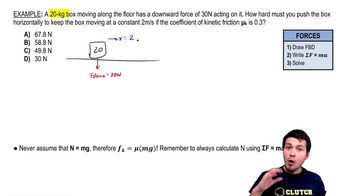
The magnitude of the kinetic frictional force is calculated using Fk = μk × N, where μk is the coefficient of kinetic friction and N is the normal force.
How much of the turning torque applied to a bolt is typically lost to friction?
A significant portion of the turning torque applied to a bolt is lost to friction, as friction resists the motion between the bolt and the surface.
What types of materials cause greater friction and which cause less friction?
Rough materials like bricks cause greater friction, while smooth materials like ice cause less friction.
Which type of friction keeps a pile of rocks from falling apart?
Static friction keeps a pile of rocks from falling apart by resisting the initiation of motion between the rocks.
Which scenario best demonstrates friction?
A box sliding across a tabletop and gradually coming to a stop best demonstrates friction.
As you push a cereal box across a tabletop, how does the sliding friction act on the cereal box?
Sliding friction acts opposite to the direction of motion of the cereal box, resisting its movement.
What should you consider when driving on a slippery highway in terms of friction?
On a slippery highway, the coefficient of kinetic friction is low, so tires have less grip and stopping distances increase.
How do you calculate the coefficient of kinetic friction (μk) between a block and a tabletop?
The coefficient of kinetic friction (μk) is calculated by dividing the kinetic friction force by the normal force: μk = Fk / N.
How would you rank crates based on the frictional force acting on them?
Crates with higher normal force or higher coefficient of kinetic friction will experience greater frictional force, as Fk = μk × N.
How do ball bearings reduce friction in machinery?
Ball bearings reduce friction in machinery by replacing sliding friction between surfaces with rolling friction, which is much lower. This minimizes resistance and allows parts to move more smoothly.
What is the effect of friction on a moving object?
Friction acts as a resisting force opposite to the direction of motion, causing a moving object to slow down and eventually stop if no other forces act on it.
 Back
Back
 03:51
03:51