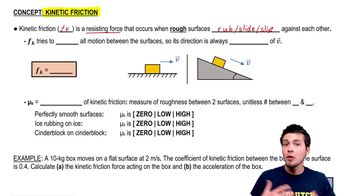
Which type of surface is likely to have the least friction?
A perfectly smooth surface, which has a coefficient of kinetic friction close to zero, is likely to have the least friction.
What factors affect the friction force between two surfaces?
The friction force between two surfaces is affected by the coefficient of kinetic friction (which depends on the roughness of the surfaces) and the normal force pressing the surfaces together.
What impact does friction have on machines?
Friction in machines causes resistance to motion, leading to energy loss as heat, increased wear and tear, and reduced efficiency.
What are some methods to reduce friction?
Methods to reduce friction include using lubricants, making surfaces smoother, and using ball bearings to replace sliding with rolling motion.
How can friction be reduced between moving parts?
Friction can be reduced between moving parts by applying lubricants, using smoother materials, or incorporating ball bearings.
What is the direction of the kinetic friction force relative to the velocity of a moving object?
The kinetic friction force always acts in the direction opposite to the velocity of the moving object. This opposing direction works to slow down or stop the motion.
How is the normal force related to the weight of an object on a flat surface when calculating kinetic friction?
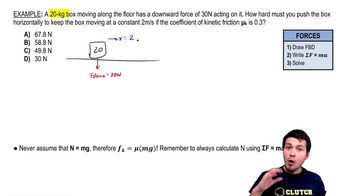
On a flat surface with only gravity and the normal force acting vertically, the normal force equals the object's weight (mg). This means N = mg for the purposes of calculating kinetic friction.
What does a coefficient of kinetic friction (μk) close to 1 indicate about the surfaces in contact?
A coefficient of kinetic friction close to 1 indicates that the surfaces are very rough and produce a high amount of friction. This results in significant resistance to sliding motion.
In the example of a 10 kg box sliding at 2 m/s with μk = 0.4, what is the calculated kinetic friction force?
The kinetic friction force is calculated as Fk = μk × N = 0.4 × (10 × 9.8) = 39.2 N. This force acts opposite to the direction of motion.
Why does the acceleration of the box in the example come out negative, and what does this signify?
The acceleration is negative because the friction force acts opposite to the direction of velocity, causing the box to slow down. A negative acceleration indicates deceleration of the moving object.
 Back
Back
 03:51
03:51