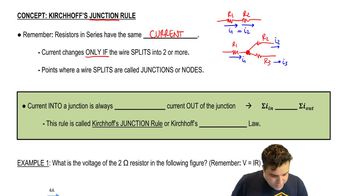
What does Kirchhoff's Junction Rule state about the currents at a junction in an electrical circuit?
Kirchhoff's Junction Rule states that the total current entering a junction equals the total current leaving the junction, reflecting the conservation of charge.
Who formulated the rule that the current entering a junction must equal the total current leaving that junction in a circuit?
Kirchhoff formulated the rule that the current entering a junction must equal the total current leaving that junction.
Which of the following statements about Kirchhoff's Current Law is incorrect: (a) The sum of currents entering a junction equals the sum of currents leaving, (b) Charge can accumulate at a junction, (c) The law is based on conservation of charge?
The incorrect statement is: (b) Charge can accumulate at a junction. According to Kirchhoff's Current Law, charge does not accumulate at a junction; the current entering equals the current leaving.
Is it correct to say that charge can build up at a junction according to Kirchhoff's Current Law?
No, it is not correct. Kirchhoff's Current Law states that charge cannot build up at a junction; the current entering equals the current leaving, ensuring conservation of charge.
Does Kirchhoff's Current Law allow for the possibility that the sum of currents entering a junction is different from the sum of currents leaving?
No, Kirchhoff's Current Law does not allow this. The sum of currents entering a junction must always equal the sum of currents leaving the junction.
According to Kirchhoff's Current Law, what happens if the current entering a junction does not equal the current leaving?
If the current entering a junction does not equal the current leaving, charge would accumulate at the junction, which violates the conservation of charge and Kirchhoff's Current Law.
Kirchhoff's Junction Rule is a statement of which fundamental physical principle?
Kirchhoff's Junction Rule is a statement of the conservation of charge.
What happens to the current through resistors in series according to the video explanation?
The current through resistors in series remains the same because the wire does not break and charges have nowhere else to go. This ensures that all the current flows through each resistor in the series path.
How does Kirchhoff's Junction Rule help determine the current through a specific branch when multiple currents are involved at a junction?
Kirchhoff's Junction Rule allows you to subtract the known outgoing currents from the total incoming current to find the unknown branch current. This ensures that the sum of currents leaving equals the sum entering, maintaining charge conservation.
Which law is used to calculate the voltage across a resistor when the current and resistance are known, as shown in the example?
Ohm's Law is used to calculate the voltage across a resistor by multiplying the current through the resistor by its resistance. In the example, this gives a voltage of 2 volts for a 2-ohm resistor with 1 amp of current.