Skip to main content
Physics with Calculus
My Course
Learn
Exam Prep
AI Tutor
Study Guides
Textbook Solutions
Flashcards
Explore
Try the app
My Course
Learn
Exam Prep
AI Tutor
Study Guides
Textbook Solutions
Flashcards
Explore
Try the app
Back
Kirchhoff's Loop Rule definitions
You can tap to flip the card.
Kirchhoff's Loop Rule
You can tap to flip the card.
👆
Kirchhoff's Loop Rule
States that the sum of all voltages in a closed loop is zero, crucial for analyzing circuits with multiple voltage sources.
Track progress
Control buttons has been changed to "navigation" mode.
1/15
Related flashcards
Related practice
Recommended videos
Kirchhoff's Loop Rule quiz #1
Kirchhoff's Loop Rule
10 Terms
Kirchhoff's Loop Rule
27. Resistors & DC Circuits
6 problems
Topic
Patrick
Solving Resistor Circuits
27. Resistors & DC Circuits
6 problems
Topic
Patrick
27. Resistors & DC Circuits - Part 1 of 2
4 topics
12 problems
Chapter
Patrick
27. Resistors & DC Circuits - Part 2 of 2
5 topics
14 problems
Chapter
Patrick
Guided course
6:58
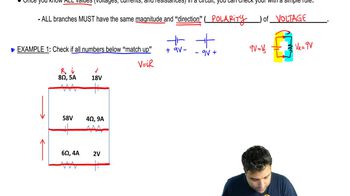
How to Check Your Work (Kirchhoff's Rules)
6777
views
96
rank
8
comments
Guided course
09:49
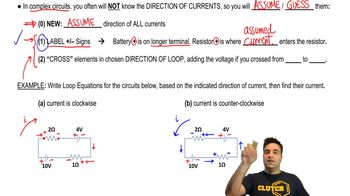
Direction of Current in Loop Equations
10223
views
173
rank
9
comments
Guided course
12:35
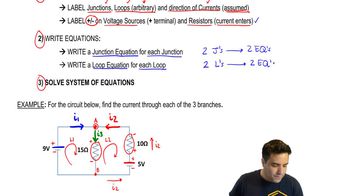
Solving Circuits with Multiple Sources
9506
views
182
rank
22
comments
Terms in this set (15)
Hide definitions
Kirchhoff's Loop Rule
States that the sum of all voltages in a closed loop is zero, crucial for analyzing circuits with multiple voltage sources.
Voltage Law
Another name for Kirchhoff's Loop Rule, emphasizing the addition of voltages in a loop.
Loop Equation
An equation derived from Kirchhoff's Loop Rule, summing voltages around a circuit loop to zero.
Ohm's Law
A fundamental principle stating that voltage equals current times resistance (V=IR).
Series Circuit
A circuit configuration where components are connected end-to-end, sharing the same current.
Voltage Source
A component, like a battery, that provides electrical potential energy in a circuit.
Polarity
The orientation of positive and negative terminals in a circuit element, crucial for voltage direction.
Current Direction
The path that electric charge flows through a circuit, influencing voltage addition or subtraction.
Resistor
A component that resists the flow of electric current, causing a voltage drop proportional to current.
Equivalent Voltage
The net voltage in a circuit after combining multiple voltage sources, considering their directions.
Branch
A part of a circuit with a single path for current flow, often compared for voltage consistency.
Magnitude
The absolute value of a quantity, such as voltage or current, without regard to direction.
Clockwise
A direction of loop traversal in a circuit, affecting the sign of voltages in loop equations.
Counterclockwise
The opposite of clockwise, another possible direction for loop traversal in circuit analysis.
Simplified Circuit
A reduced version of a circuit achieved by combining elements like resistors or voltage sources.
 BackBack
 6:58
6:58