What does Kirchhoff's Voltage Law (Loop Rule) state in the context of electric circuits?
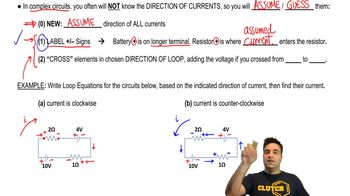
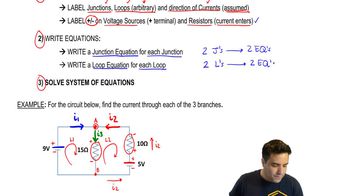
Kirchhoff's Voltage Law states that the sum of all voltages around any closed loop in a circuit is zero. This means that when you add up the voltage drops and rises (from batteries and resistors) as you move around a loop, the total must equal zero. This law is essential for analyzing circuits with multiple sources and resistors.
How do you determine the sign of the voltage across a resistor when applying Kirchhoff's Loop Rule?
The sign is positive where the current enters the resistor and negative where it exits. This helps assign correct voltage polarities when writing loop equations.
What happens to the loop equation if you traverse the circuit in the opposite direction?
The loop equation remains the same regardless of the direction you choose to traverse the loop. This means you can pick any direction and still get the correct result.
When combining voltage sources in series, how do you determine the equivalent voltage if the sources are oriented in opposite directions?
You subtract the voltages if the sources are oriented in opposite directions. The resulting equivalent voltage is in the direction of the stronger source.
How can you use Ohm's Law to find the voltage across a resistor in a circuit analyzed with Kirchhoff's Loop Rule?
You multiply the current through the resistor by its resistance (V = IR). This value is then used in the loop equation with the appropriate sign.
What is a quick method to double-check your circuit solution after applying Kirchhoff's Loop Rule?
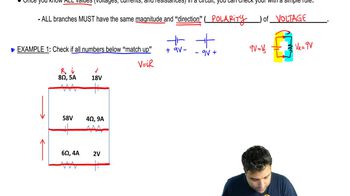
Check that all branches have the same magnitude and polarity of voltage. This ensures consistency and helps catch calculation errors.
Why is it important to assign positive and negative signs to the terminals of batteries and resistors before writing loop equations?
Assigning signs ensures you correctly add or subtract voltages as you traverse the loop. This step is crucial for accurate loop equations.
What does it mean for two batteries in series to 'help' or 'fight' each other in a circuit?
Batteries 'help' each other if their positive terminals push current in the same direction, so their voltages add. They 'fight' if they push in opposite directions, so their voltages subtract.
How do you determine the direction of the net current when two batteries in series oppose each other?
The net current flows in the direction of the battery with the larger voltage. The effective voltage is the difference between the two battery voltages.
What does matching the polarity of voltages across branches mean when checking your circuit solution?
It means the positive and negative sides of the voltages must align in all branches. This ensures the circuit's voltages are consistent with the sources and elements.
 Back
Back
 6:58
6:58