LC Circuits definitions Flashcards
You can tap to flip the card.
Control buttons has been changed to "navigation" mode.
1/15
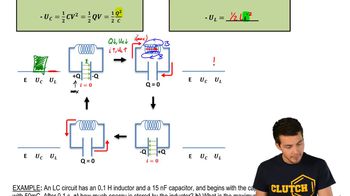
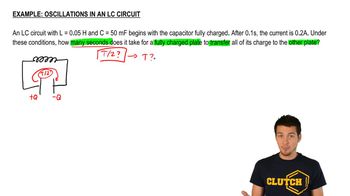
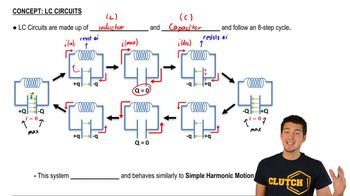
LC CircuitA circuit consisting of an inductor and a capacitor that oscillates charge and current in a cycle without external energy input.InductorA component in an LC circuit that resists changes in current and stores energy in a magnetic field.CapacitorA device in an LC circuit that stores electrical energy in an electric field and releases it as current.OscillationThe repetitive variation in charge and current in an LC circuit, similar to simple harmonic motion.Simple Harmonic MotionA type of periodic motion where the restoring force is proportional to the displacement, analogous to LC circuit behavior.Angular FrequencyThe rate of oscillation in an LC circuit, calculated as the square root of 1/(LC).Phase AngleA constant in the sinusoidal function of an LC circuit that determines the starting point of oscillation.Sinusoidal FunctionsMathematical functions, such as sine and cosine, used to describe the charge and current in an LC circuit.Maximum CurrentThe peak current in an LC circuit, calculated as omega times the maximum charge.Energy ConservationThe principle that energy in an LC circuit is conserved, oscillating between electrical and magnetic forms.Electric FieldThe field between capacitor plates where electrical energy is stored in an LC circuit.Magnetic FieldThe field generated by current through an inductor, storing magnetic energy in an LC circuit.Radians ModeCalculator setting required for trigonometric calculations in LC circuit formulas.Potential EnergyEnergy stored in a system, analogous to electrical energy in a charged capacitor.Kinetic EnergyEnergy of motion, analogous to magnetic energy in an LC circuit with maximum current.