What are the key characteristics of magnetic field line patterns produced by current-carrying loops and solenoids, and how can you identify if a given field line pattern represents a magnetic field?
Magnetic field lines produced by current-carrying loops form closed loops: inside the loop (or solenoid), the field lines are nearly straight and uniform, pointing from one face to the other (out of the page for counterclockwise current, into the page for clockwise current at the center). Outside the loop or solenoid, the field lines curve around and return, forming continuous closed loops. In solenoids, the field inside is strong and uniform, while outside it is weaker and resembles the field of a bar magnet, extending from the 'north' to the 'south' pole. A valid magnetic field pattern must have continuous, closed field lines with no beginning or end, and the direction of the field lines should be consistent with the right-hand rule for the current direction.
How does the right-hand rule differ when determining the magnetic field direction for a straight wire versus a current-carrying loop?
For a straight wire, the thumb points in the direction of current and the curled fingers show the magnetic field direction; for a loop, the curled fingers follow the current and the thumb points in the direction of the magnetic field at the center. This reversal helps visualize the field orientation in each case.
What is the formula for the magnetic field at the center of a single circular loop, and what does each variable represent?
The formula is B = μ₀IN/(2R), where μ₀ is the permeability of free space, I is the current, N is the number of loops, and R is the radius of the loop. This gives the field strength at the exact center of the loop.
How does increasing the number of loops in a coil affect the strength of the magnetic field at the center?
Increasing the number of loops (N) increases the magnetic field strength proportionally at the center. For example, doubling the number of loops doubles the field strength.
What is the difference between the variable 'r' in the straight wire formula and 'R' in the loop formula for magnetic field calculations?
'r' in the straight wire formula refers to the distance from the wire, while 'R' in the loop formula refers to the radius of the loop itself. This distinction is crucial for applying the correct formula.
How do you determine the direction of the magnetic field inside and outside a current-carrying loop based on the current's direction?
If the current is counterclockwise, the magnetic field at the center points out of the page; if clockwise, it points into the page. Outside the loop, the field direction is reversed compared to the center.
What is the formula for the total length of wire needed to make N loops of radius R, and why is this useful?
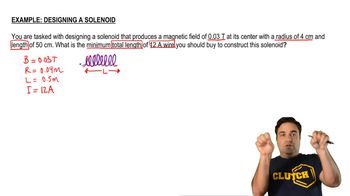
The total length is 2πRN, where R is the radius and N is the number of loops. This helps determine how much wire is required for constructing coils or solenoids.
How does the formula for the magnetic field inside a long solenoid differ from that of a single loop?
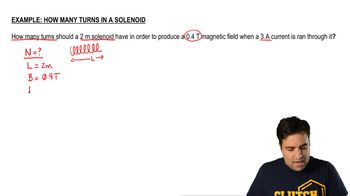
For a long solenoid, the field is B = μ₀IN/L, where L is the solenoid's length and N is the total number of loops. This formula accounts for the cumulative effect of many closely spaced loops.
What does the variable 'n' represent in the context of solenoids, and how is it calculated?
'n' represents the number of loops per meter (loop density) and is calculated as N/L, where N is the total number of loops and L is the solenoid's length. It indicates how tightly the loops are wound.
How do the magnetic field lines of a solenoid compare to those of a bar magnet?
The magnetic field lines of a solenoid emerge from the 'north' end and enter the 'south' end, similar to a bar magnet. Outside the solenoid, the field lines loop from north to south, mimicking the pattern of a bar magnet's field.