Magnetic Flux quiz #1 Flashcards

Magnetic Flux quiz #1
Control buttons has been changed to "navigation" mode.
1/10
  • What is the magnetic flux through a loop when the loop is perpendicular to the magnetic field inside a solenoid?
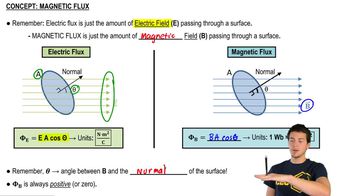
    When the loop is perpendicular to the magnetic field, the angle θ between the field and the normal to the surface is 0 degrees. The magnetic flux is given by Φ_B = B × A × cos(θ). Since cos(0°) = 1, the flux is Φ_B = B × A.
  • How do you calculate the magnetic flux across a surface when given the magnetic field strength, the area of the surface, and the angle between the field and the normal to the surface?
    The magnetic flux across a surface is calculated using Φ_B = B × A × cos(θ), where B is the magnetic field strength, A is the area of the surface, and θ is the angle between the magnetic field and the normal to the surface.
  • Why does the magnetic flux through a bracelet change when the orientation of the bracelet relative to the magnetic field changes?
    The magnetic flux through the bracelet changes because the angle θ between the magnetic field and the normal to the surface of the bracelet changes, affecting the value of cos(θ) in the flux formula Φ_B = B × A × cos(θ).
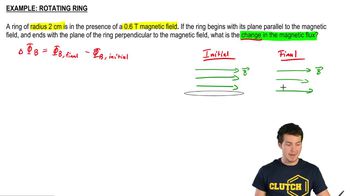
  • What is the magnitude of the magnetic flux through one turn of a coil before it is rotated, assuming the coil's plane is perpendicular to the magnetic field?
    If the coil's plane is perpendicular to the magnetic field, the angle θ is 0 degrees, so the magnetic flux through one turn is Φ_B = B × A × cos(0°) = B × A.
  • What does the angle θ in the magnetic flux formula specifically represent?
    The angle θ represents the angle between the magnetic field direction and the normal (perpendicular) to the surface. It is not the angle between the field and the plane of the surface.
  • How do you determine the area to use in the magnetic flux formula for a square surface?
    For a square surface, the area is calculated as the side length squared. For example, if the side is 5 meters, the area is 25 m².
  • What is the unit of magnetic flux and how is it related to other SI units?
    The unit of magnetic flux is the Weber (Wb). One Weber is equivalent to one Tesla times one meter squared (T·m²).
  • If given the angle between the magnetic field and the plane of a surface, how do you find the correct angle for the flux calculation?
    You subtract the given angle from 90 degrees to get the angle between the field and the normal. This new angle is then used in the cosine term of the flux formula.
  • Why are magnetic flux values always positive according to the video?
    Magnetic flux values are always positive because the convention is to align the normal vector with the magnetic field direction. This ensures the cosine term is positive.
  • What is the significance of the normal vector when calculating magnetic flux through a surface?
    The normal vector defines the direction perpendicular to the surface and is used to measure the angle with the magnetic field. This angle is crucial for correctly applying the cosine in the flux formula.