What happens when two parallel wires carry currents in the same direction and are placed close to each other?
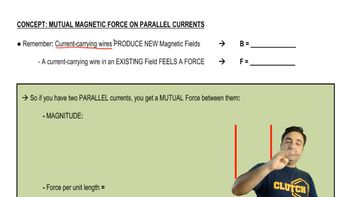
When two parallel wires carry currents in the same direction, they attract each other due to the magnetic force between them.
How can you determine if a piece of metal is magnetic in the context of magnetic forces between parallel currents?
A piece of metal is considered magnetic if it can interact with a magnetic field, such as being attracted or repelled by a current-carrying wire that produces a magnetic field.
What type of force exists between two parallel wires carrying current in the same direction?
There is an attractive force between two parallel wires carrying current in the same direction.
What rule do you use to determine the direction of the magnetic field around a current-carrying wire?
You use the right-hand rule by grabbing the wire with your right hand so your thumb points in the direction of the current. Your fingers then curl in the direction of the magnetic field lines.
How does the force experienced by one wire relate to the force experienced by the other wire in the parallel current setup?
The forces are equal in magnitude and opposite in direction due to Newton's third law. Each wire exerts the same size force on the other, but in opposite directions.
What is the formula for the magnetic field produced at a distance r from a long, straight current-carrying wire?
The formula is B = μ₀I / (2πr), where μ₀ is the permeability of free space, I is the current, and r is the distance from the wire. This gives the magnetic field strength at that point.
If two parallel wires carry currents in opposite directions, what is the nature of the force between them?
The wires will repel each other. This is because the direction of the magnetic field and current combine to produce a repulsive force.
How do you calculate the force per unit length between two parallel wires carrying currents I1 and I2 separated by distance r?
The force per unit length is given by F/L = μ₀I₁I₂ / (2πr). This formula allows you to find the force for any length of wire.
What is the value and unit of the permeability of free space (μ₀) used in these calculations?
The permeability of free space μ₀ is 4π × 10⁻⁷ T·m/A. It is a constant used in magnetic field and force calculations.
In the example with two wires 10 meters long and 0.5 meters apart, with currents of 2A and 3A in opposite directions, what is the direction of the force on the top wire?
The force on the top wire is directed upward. This is because the opposite currents cause the wires to repel each other.
 Back
Back
 10:11
10:11