Paperclips are attracted to magnets because they are made of materials like iron, which can be influenced by magnetic fields. The magnetic field from the magnet causes the domains in the iron to align, creating a net magnetic effect that attracts the paperclip to the magnet.
What does a moving electric charge experience when it is near a magnetic field?
A moving electric charge near a magnetic field experiences a magnetic force. The direction and magnitude of this force are given by the equation F = qvB sin(θ), where θ is the angle between the velocity of the charge and the magnetic field direction.
How do you determine the direction of the magnetic force on a current-carrying wire in a magnetic field?
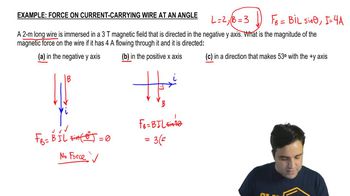
The direction of the magnetic force on a current-carrying wire in a magnetic field is determined using the right-hand rule: point your thumb in the direction of the current and your fingers in the direction of the magnetic field; your palm then points in the direction of the force.
When is the force on a current-carrying wire in a magnetic field at its strongest?
The force on a current-carrying wire in a magnetic field is at its strongest when the current and the magnetic field are perpendicular to each other, that is, when the angle θ between them is 90 degrees, making sin(θ) = 1.
Why is every piece of iron not a magnet?
Not every piece of iron is a magnet because, in most cases, the magnetic domains within the iron are randomly oriented, canceling out any net magnetic effect. Only when these domains are aligned does the iron become magnetized.
Can you produce current in a wire with a magnet that is sitting still relative to the wire?
No, you cannot produce current in a wire with a magnet that is sitting still relative to the wire. Current is only induced when there is relative motion between the wire and the magnetic field.
What condition will always produce a magnetic force on a nearby iron nail?
A magnetic force will always be produced on a nearby iron nail if there is a magnetic field present, such as from a current-carrying wire or a permanent magnet, because the iron nail is susceptible to magnetic fields.
How should the current in a second parallel wire be chosen so that the magnetic field at a point between the wires is zero?
To make the magnetic field at a point between two parallel wires zero, the currents in the wires should be in opposite directions and have magnitudes such that the magnetic fields they produce at the point cancel each other out. The relationship is given by μ₀I₁/(2πr₁) = μ₀I₂/(2πr₂), where r₁ and r₂ are the distances from the point to each wire.
Using the left-hand rule for generators, what does the center finger indicate the direction of?
Using the left-hand rule for generators, the center finger indicates the direction of the induced current.
What effect does reversing the direction of current in a wire have on the direction of the magnetic force it experiences in a magnetic field?
Reversing the direction of the current in the wire reverses the direction of the magnetic force acting on it. This is because the right-hand rule shows that flipping the current flips the force direction relative to the magnetic field.
 Back
Back
 09:57
09:57