What do magnetic field lines look like when two magnets are positioned so that their like poles face each other and repel?
When two magnets repel, the magnetic field lines between their like poles (e.g., North-North or South-South) curve outward, showing that the field lines do not connect directly between the magnets but instead bend away from each other, indicating repulsion.
What happens when you place two magnets close together?
When two magnets are placed close together, they exert magnetic forces on each other. If opposite poles face each other, they attract; if like poles face each other, they repel.
How do you determine the direction of the magnetic field at a specific point near a magnet?
The direction of the magnetic field at a point near a magnet is given by the tangent to the magnetic field line at that point, which points from the North pole to the South pole outside the magnet.
How is the magnetic field strength at a point near a magnet generally characterized?
The magnetic field strength at a point near a magnet is strongest near the poles and decreases with distance from the magnet. It can be represented by the density of magnetic field lines at that location.
What produces magnetic fields?
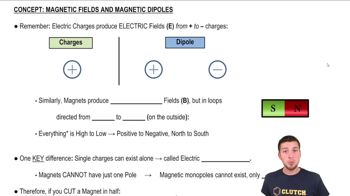
Magnetic fields are produced by magnets and by moving electric charges, such as currents in wires. In materials, magnetic fields arise from the alignment of magnetic domains.
How can magnets attract or repel each other without touching?
Magnets attract or repel each other without touching because their magnetic fields exert forces at a distance, similar to how electric fields act between charges.
What is the direction of the magnetic force that a solenoid exerts on a nearby bar magnet?
The direction of the magnetic force that a solenoid exerts on a bar magnet depends on the orientation of the magnet's poles relative to the solenoid's field: opposite poles attract, and like poles repel, with the force directed along the axis connecting the poles.
To which end of a magnetized compass needle is the needle attracted?
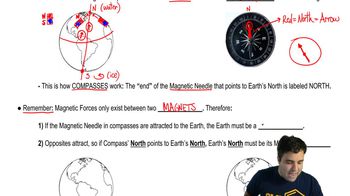
The North end of a magnetized compass needle is attracted to the Earth's geographic North, which is actually the Earth's magnetic South pole.
Will two magnets with opposite poles facing each other be attracted or repelled?
Two magnets with opposite poles facing each other will be attracted to each other.
Which types of materials are attracted by a magnet?
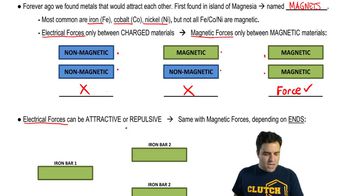
Materials such as iron, cobalt, and nickel are attracted by a magnet because they possess magnetic properties.
What happens when a compass is used near a magnet?
When a compass is used near a magnet, its needle aligns with the local magnetic field, with the North end of the needle pointing in the direction of the magnetic field lines.
In which direction does the magnetic field in the center of a coil (solenoid) point?
The magnetic field in the center of a coil (solenoid) points from the coil's South end to its North end, following the direction of the field lines inside the coil.
Which materials are attracted to a magnet?
Materials that are attracted to a magnet include iron, cobalt, and nickel.
What is the direction of movement of a compass needle in a magnetic field?
A compass needle moves so that its North end points in the direction of the magnetic field lines at its location.
Where is the magnetic force strongest around a magnet?
The magnetic force is strongest near the poles of a magnet.
What is the direction of the magnetic field produced by one current-carrying wire at the location of another parallel wire?
The direction of the magnetic field produced by one wire at the location of another parallel wire depends on the direction of the current; it follows the right-hand rule, circling around the wire.
Can a spinning magnet create an electric field that moves electrons in a nearby wire?
Yes, a spinning magnet can create a changing magnetic field, which induces an electric field that can move electrons in a nearby wire (electromagnetic induction).
Which type of magnet can have its polarity reversed?
An electromagnet can have its polarity reversed by changing the direction of the electric current through its coil.