Mass Distribution with Calculus definitions Flashcards
Mass Distribution with Calculus definitions
You can tap to flip the card.
Control buttons has been changed to "navigation" mode.
1/15
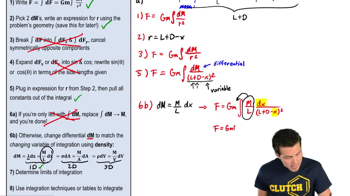
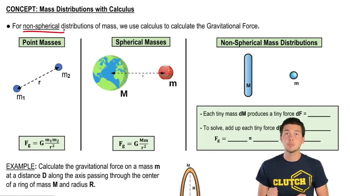
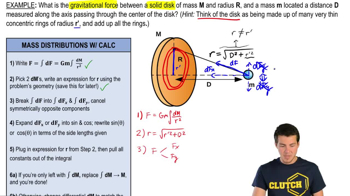
Gravitational ForceThe force of attraction between two masses, calculated using Newton's law of gravity.Non-spherical Mass DistributionA mass configuration that cannot be approximated as a point mass at its center.Differential Mass (DM)A small segment of mass used in calculus to approximate a continuous mass distribution.Differential Force (DF)The infinitesimal force generated by a differential mass in a gravitational field.IntegralA mathematical operation used to sum infinitesimal quantities, such as forces or masses.Center of Mass DistanceThe distance from a point mass to the center of mass of a distribution.Vector DecompositionThe process of breaking a vector into its component parts, typically along orthogonal axes.CosineA trigonometric function representing the adjacent side over the hypotenuse in a right triangle.HypotenuseThe longest side of a right triangle, opposite the right angle.Pythagorean TheoremA mathematical relation in a right triangle: the square of the hypotenuse equals the sum of the squares of the other two sides.ConstantsValues that do not change during the integration process, such as G and M in gravitational calculations.Radius of the RingThe fixed distance from the center to any point on the circumference of a ring.Distance (D)The horizontal distance from a point mass to the center of a mass distribution.Three Halves PowerAn exponent indicating a value raised to the power of 1.5, often seen in gravitational formulas.Mass (M)The total amount of matter in an object, often used as a constant in gravitational equations.