Which particle has negligible mass in the context of a mass spectrometer?
Electrons have negligible mass compared to other particles like protons or ions.
What is the purpose of ionization in a mass spectrometer?
Ionization adds or removes electrons to charge particles, allowing them to feel magnetic and electric forces necessary for acceleration and velocity selection.
How does a mass spectrometer accelerate charged particles?
Charged particles are accelerated through a potential difference, creating an electric field that pushes them, resulting in increased velocity.
What is the role of the velocity selector in a mass spectrometer?
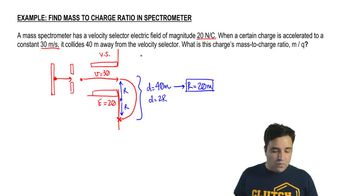
The velocity selector filters particles by speed, allowing only those with the desired velocity to pass through by balancing electric and magnetic forces.
How is the direction of the magnetic field in the velocity selector determined?
The direction is determined using the right-hand rule, ensuring the magnetic force cancels the electric force for particles with the target velocity.
What happens to particles after they pass through the velocity selector?
Particles move in a circular path due to the magnetic field, with the radius of this path used to calculate the mass of the particles.
What equation relates charge, potential difference, and kinetic energy in a mass spectrometer?
The equation Q Delta V = Delta K relates charge and potential difference to the change in kinetic energy of the particles.
How is the velocity of particles determined in a mass spectrometer?
The velocity is determined using the equation V = E/B, where E is the electric field and B is the magnetic field.
What is the equation for the radius of the particle path in a mass spectrometer?
The equation R = M V / Q B is used to calculate the radius of the particle path, where M is mass, V is velocity, Q is charge, and B is the magnetic field.
Why is it important to control the speed of particles in a mass spectrometer?
Controlling the speed ensures that only particles with the desired velocity pass through the velocity selector, allowing accurate mass measurement.
What is the significance of the right-hand rule in mass spectrometry?
The right-hand rule helps determine the direction of the magnetic field needed to balance forces and allow particles with the correct velocity to pass through.
 Back
Back


 20:32
20:32