Moment of Inertia via Integration definitions Flashcards

Moment of Inertia via Integration definitions
Control buttons has been changed to "navigation" mode.
1/15
  • Moment of Inertia
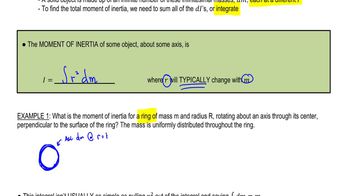
    A measure of an object's resistance to changes in its rotation, dependent on mass distribution relative to the axis.
  • Integration
    A mathematical process used to calculate quantities like moment of inertia by summing infinitesimal contributions.
  • Disc
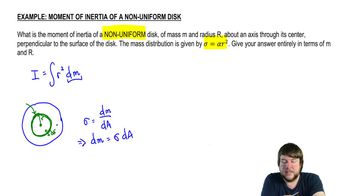
    A flat, circular object whose moment of inertia is calculated by integrating over varying radii.
  • Ring
    A circular object with mass concentrated at a constant radius, simplifying its moment of inertia to MR^2.
  • Axis of Rotation
    The line about which an object rotates, crucial in determining the moment of inertia.
  • Mass Element
    An infinitesimally small portion of mass, denoted as dm, used in integration to find moment of inertia.
  • Radius
    The distance from the axis of rotation to a point in the object, affecting the moment of inertia.
  • Surface Density
    Mass per unit area of an object, denoted as sigma, used in calculating moment of inertia for a disc.
  • Infinitesimal
    An extremely small quantity used in calculus to approximate continuous distributions.
  • Circumference
    The perimeter of a circle, used in calculating the area of a thin ring in moment of inertia problems.
  • Thickness
    The small width of a thin ring, used with circumference to find the area in moment of inertia calculations.
  • Uniform Distribution
    A consistent spread of mass across an object, simplifying calculations of moment of inertia.
  • Rotational Axis
    Another term for the axis of rotation, around which the moment of inertia is calculated.
  • Infinitesimal Mass
    A very small mass element, denoted as dm, used in integration to calculate moment of inertia.
  • Area Element
    A small section of area, denoted as dA, used in integration to find mass distribution in a disc.