Moment of Inertia via Integration quiz #1 Flashcards

Moment of Inertia via Integration quiz #1
Control buttons has been changed to "navigation" mode.
1/10
  • Which has the smallest moment of inertia: a ring or a disc of the same mass and radius, both rotating about an axis through their center perpendicular to the surface?
    A disc has the smaller moment of inertia. For a ring, the moment of inertia is MR^2, while for a disc it is (1/2)MR^2.
  • On which factors does the moment of inertia of an object depend?
    The moment of inertia of an object depends on the mass of the object, the distribution of mass relative to the axis of rotation, and the distance of each mass element from the axis.
  • How do you determine the moment of inertia of a composite area about the y-axis using integration?
    To determine the moment of inertia of a composite area about the y-axis, divide the area into simple shapes, calculate the moment of inertia of each shape about the y-axis (using integration if necessary), and sum the individual moments of inertia, considering the parallel axis theorem if the axis does not pass through the centroid of each shape.
  • If the flywheel of an engine has a moment of inertia of 1.10 kg·m² about its rotation axis, what does this value represent?
    This value represents the flywheel's resistance to changes in its rotational motion about the specified axis; a higher moment of inertia means it is harder to change the rotational speed.
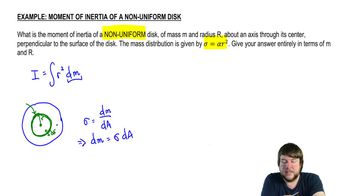
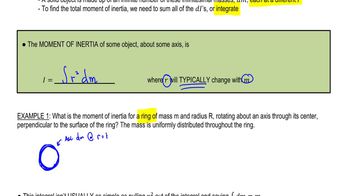
  • Why can't you simply pull r squared out of the integral when calculating the moment of inertia for a disc?
    Because the mass elements are located at different radii, r varies with each dm, so r squared cannot be treated as a constant in the integration. This requires expressing dm in terms of r before integrating.
  • What is the expression for the infinitesimal moment of inertia contributed by a point mass at distance r from the axis?
    The infinitesimal moment of inertia is dI = r^2 dm. This represents the contribution of a tiny mass element located at radius r.
  • How do you express the mass element dm for a uniformly distributed disc in terms of surface density and area?
    For a uniformly distributed disc, dm = sigma dA, where sigma is the surface mass density and dA is the infinitesimal area. Sigma is calculated as the total mass divided by the total area of the disc.
  • What is the area of a very thin ring at radius r and infinitesimal thickness dr in a disc?
    The area of a thin ring is given by the circumference times the thickness, or 2πr dr. This formula is used to find the mass contained in the ring during integration.
  • When integrating to find the moment of inertia of a disc, what are the limits of integration for the radius?
    The limits of integration are from r = 0 at the center of the disc to r = R at the rim. This ensures all mass elements from the center to the edge are included.
  • Why is the surface mass density sigma considered a constant when integrating for a uniformly distributed disc?
    Sigma is constant because the mass is spread uniformly across the entire disc. This uniformity allows sigma to be factored out of the integral.