Skip to main content
Physics with Calculus
My Course
Learn
Exam Prep
AI Tutor
Study Guides
Textbook Solutions
Flashcards
Explore
Try the app
My Course
Learn
Exam Prep
AI Tutor
Study Guides
Textbook Solutions
Flashcards
Explore
Try the app
Back
More 2D Equilibrium Problems definitions
You can tap to flip the card.
Inclined Beam
You can tap to flip the card.
👆
Inclined Beam
A structural element positioned at an angle, subject to forces and torques, analyzed for equilibrium.
Track progress
Control buttons has been changed to "navigation" mode.
1/15
Related flashcards
Related practice
Recommended videos
More 2D Equilibrium Problems quiz
More 2D Equilibrium Problems
15 Terms
More 2D Equilibrium Problems
15. Rotational Equilibrium
3 problems
Topic
Patrick
Review: Center of Mass
15. Rotational Equilibrium
5 problems
Topic
15. Rotational Equilibrium - Part 1 of 2
4 topics
9 problems
Chapter
Patrick
15. Rotational Equilibrium - Part 2 of 2
4 topics
12 problems
Chapter
Patrick
Guided course
15:00
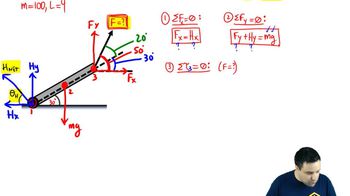
Inclined beam against the floor
5609
views
24
rank
5
comments
Terms in this set (15)
Hide definitions
Inclined Beam
A structural element positioned at an angle, subject to forces and torques, analyzed for equilibrium.
Equilibrium
A state where the sum of forces and torques on a system is zero, resulting in no motion.
Torque
A measure of the rotational force applied at a distance from an axis, influencing angular motion.
Hinge
A support point allowing rotation, providing a pivot for analyzing forces and torques.
Vector Addition
The process of combining vectors to determine a resultant vector, crucial in force analysis.
Net Force
The overall force acting on an object, found by vectorially adding all individual forces.
Reference Axis
A chosen line or point about which torques are calculated to simplify equilibrium analysis.
Complementary Angle
An angle that, when added to another, equals 90 degrees, used in trigonometric calculations.
Pythagorean Theorem
A mathematical principle used to calculate the magnitude of a resultant vector in physics.
Arctangent
A trigonometric function used to determine an angle from the ratio of opposite to adjacent sides.
Horizontal
A direction parallel to the ground, often used as a reference in force and angle calculations.
Vertical
A direction perpendicular to the ground, significant in analyzing forces in equilibrium problems.
Force Components
The breakdown of a force into perpendicular vectors, typically along x and y axes.
Clockwise Torque
A rotational force causing a clockwise motion, considered negative in torque calculations.
Counterclockwise Torque
A rotational force causing a counterclockwise motion, considered positive in torque calculations.
 BackBack
 15:00
15:00