Opening/Closing Arms on Rotating Stool quiz #1 Flashcards

Opening/Closing Arms on Rotating Stool quiz #1
Control buttons has been changed to "navigation" mode.
1/10
  • What happens to the rotational speed of a person sitting on a rotating stool when they bring their arms (holding weights) closer to their body, and why?
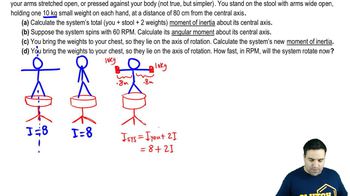
    When a person sitting on a rotating stool brings their arms (and any weights they are holding) closer to their body, their moment of inertia decreases. Due to the conservation of angular momentum (L = Iω), the decrease in moment of inertia (I) causes the rotational speed (ω) to increase, so the person spins faster.
  • How do you calculate the moment of inertia for a system consisting of a person and two point masses held at arm's length?
    Add the person's moment of inertia to twice the moment of inertia of each point mass, using I = m r^2 for each mass. The total is I_person + 2(m r^2).
  • What is the formula for converting rotational speed from RPM to angular velocity in radians per second?
    The formula is ω = 2π × RPM / 60. This converts revolutions per minute to radians per second.
  • If the weights are brought to the axis of rotation, what happens to their contribution to the system's moment of inertia?
    Their contribution becomes zero because the distance r from the axis is zero. Thus, only the person's moment of inertia remains.
  • What is the total moment of inertia of the system when the person holds two 10 kg weights at 0.8 meters from the axis and their own moment of inertia is 8 kg·m²?
    It is 8 + 2 × 10 × (0.8)^2 = 20.8 kg·m². This includes both the person and the weights.
  • How do you use conservation of angular momentum to relate initial and final RPMs when the moment of inertia changes?
    Set I_initial × RPM_initial = I_final × RPM_final, assuming no external torques. Solve for the unknown RPM using the known values.
  • What is the angular momentum of the system if the total moment of inertia is 20.8 kg·m² and the system spins at 60 RPM?
    It is L = I × ω = 20.8 × 2π = approximately 131 kg·m²/s. This uses ω = 2π rad/s for 60 RPM.
  • Why does the RPM increase when the person brings the weights closer to their body?
    The moment of inertia decreases, so to conserve angular momentum, the rotational speed (RPM) must increase. This is a direct result of L = Iω being constant.
  • What mathematical operation allows you to solve for the final RPM after the moment of inertia changes?
    You divide the product of initial moment of inertia and initial RPM by the final moment of inertia. This gives RPM_final = (I_initial × RPM_initial) / I_final.
  • If the initial RPM is 60 and the moment of inertia drops from 20.8 to 8, what is the final RPM?
    The final RPM is (20.8 × 60) / 8 = 156. This shows the RPM increases as the moment of inertia decreases.