Skip to main content
Physics with Calculus
My Course
Learn
Exam Prep
AI Tutor
Study Guides
Textbook Solutions
Flashcards
Explore
Try the app
My Course
Learn
Exam Prep
AI Tutor
Study Guides
Textbook Solutions
Flashcards
Explore
Try the app
Back
Motion Along Curved Paths definitions
You can tap to flip the card.
Curved Path Problem
You can tap to flip the card.
👆
Curved Path Problem
A scenario where an object moves along a path with a constantly changing slope angle, complicating force and kinematic analysis.
Track progress
Control buttons has been changed to "navigation" mode.
1/15
Related flashcards
Related practice
Recommended videos
Motion Along Curved Paths quiz #1
Motion Along Curved Paths
10 Terms
Motion Along Curved Paths
10. Conservation of Energy
5 problems
Topic
David-Paige
Rollercoaster Problems
10. Conservation of Energy
1 problem
Topic
10. Conservation of Energy - Part 1 of 2
7 topics
15 problems
Chapter
Patrick
10. Conservation of Energy - Part 2 of 2
4 topics
11 problems
Chapter
Guided course
04:18
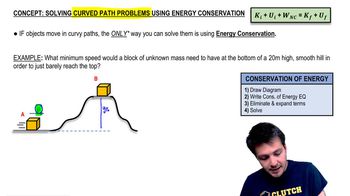
Curved Paths & Energy Conservation
8664
views
190
rank
1
comments
Terms in this set (15)
Hide definitions
Curved Path Problem
A scenario where an object moves along a path with a constantly changing slope angle, complicating force and kinematic analysis.
Energy Conservation
A principle stating that the total energy in a closed system remains constant, used to solve problems with non-constant acceleration.
Kinetic Energy
The energy an object possesses due to its motion, calculated as 1/2 times mass times velocity squared.
Potential Energy
The energy stored in an object due to its position in a gravitational field, calculated as mass times gravity times height.
Non-conservative Forces
Forces that cause energy dissipation from a system, such as friction, not present in the given problem.
Gravitational Potential Energy
Energy an object possesses due to its height above a reference point, contributing to total mechanical energy.
Minimum Speed
The lowest velocity required for an object to reach a certain point without falling short.
Acceleration due to Gravity
The constant rate at which objects accelerate towards Earth, approximately 9.8 m/s².
Hill Height
The vertical distance from the base to the top of a hill, given as 20 meters in the problem.
Initial Conditions
The starting parameters of a problem, including initial kinetic energy and zero potential energy at the base.
Final Conditions
The parameters at the end of a problem, including zero kinetic energy and maximum potential energy at the hill's peak.
Velocity
The speed of an object in a specific direction, crucial for determining kinetic energy.
Mass Cancellation
A simplification in energy equations where mass is eliminated from both sides, focusing on velocity and height.
Square Root Calculation
A mathematical operation used to solve for velocity in energy equations, involving the square root of 2g times height.
Smooth Hill
A surface with no friction, ensuring no work is done by non-conservative forces in the problem.
 BackBack

 04:18
04:18