How do you determine the speed of a car at the bottom of a dip along a curved path using energy conservation principles?
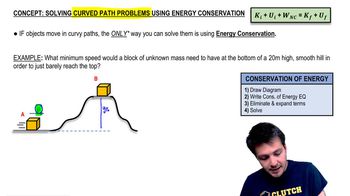
To determine the speed of a car at the bottom of a dip along a curved path, use the conservation of mechanical energy. Set the initial potential and kinetic energies at the starting point and equate them to the final potential and kinetic energies at the bottom, assuming no energy is lost to friction. The general formula is: (1/2) m v_initial^2 + m g h_initial = (1/2) m v_final^2 + m g h_final. At the bottom, h_final is minimum (often zero), so solve for v_final: v_final = sqrt(v_initial^2 + 2g(h_initial - h_final)).
 Back
Back

 04:18
04:18