Pearson+ LogoPearson+ Logo

Motional EMF quiz #1 Flashcards

Motional EMF quiz #1
Control buttons has been changed to "navigation" mode.
1/10
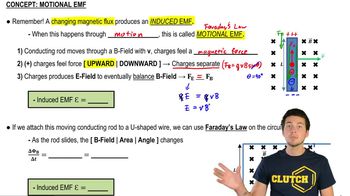
  • What is the general formula for the magnitude of the motional EMF induced in a conducting rod moving through a uniform magnetic field?

    The magnitude of the motional EMF (ε) induced in a conducting rod of length L moving with velocity v perpendicular to a uniform magnetic field B is given by ε = vBL.
  • What physical process causes the separation of charges in a conducting rod moving through a magnetic field?

    The magnetic force acts on the charges in the rod, pushing positive charges to one end and negative charges to the other. This separation creates an internal electric field within the rod.
  • How does the right-hand rule help determine the direction of the magnetic force on charges in a moving rod?

    The right-hand rule involves pointing your fingers in the direction of the magnetic field and your thumb in the direction of velocity, with your palm indicating the direction of the force on positive charges. This helps identify which end of the rod accumulates positive or negative charges.
  • What balances the magnetic force on charges in the rod as they separate?

    The electric field created by the separated charges exerts an electric force that balances the magnetic force. This equilibrium prevents further charge separation.
  • Why can the sine of theta term be dropped when calculating the magnetic force in this scenario?

    The angle between the velocity and the magnetic field is 90 degrees, making sine of theta equal to 1. This simplifies the force equation to just qvB.
  • How is the induced EMF in a moving rod related to the electric field and the length of the rod?

    The induced EMF equals the electric field multiplied by the length of the rod. Since the electric field is vB, the EMF becomes vBL.
  • When the moving rod is part of a loop, which variable changes to produce a changing magnetic flux?

    The area enclosed by the loop changes as the rod moves, altering the magnetic flux. The magnetic field and angle remain constant in this setup.
  • How is the change in area related to the velocity of the rod in the context of Faraday's Law?

    The change in area per unit time is equal to the length of the rod times its velocity. This relationship allows the induced EMF to be expressed as vBL.
  • What formula is used to calculate the induced current in the circuit formed by the moving rod and wire?

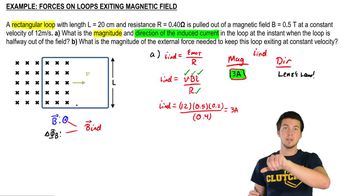
    The induced current is calculated by dividing the induced EMF by the resistance of the circuit. This is an application of Ohm's Law: I = ε/R.
  • Which formula is used to calculate the power output in the circuit, given the induced current and resistance?

    The power output is calculated using P = I^2R, where I is the induced current and R is the resistance. This gives the rate at which electrical energy is delivered to the circuit.