How do you determine the net force acting on an object when multiple forces are applied in different directions?
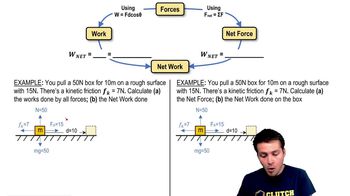
To determine the net force acting on an object, sum all the individual forces acting on the object, taking into account their directions. For forces along the same axis, add the forces algebraically (positive for one direction, negative for the opposite). Forces perpendicular to the direction of motion, such as normal force and gravity in horizontal motion, typically cancel each other out and do not contribute to the net force in the direction of motion.
What tools or information does a student need to calculate the net work done on an object?
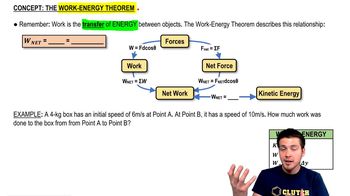
To calculate the net work done on an object, a student needs to know either: (1) the magnitude and direction of all individual forces acting on the object and the displacement, so they can use the formula W = Fd cos(θ) for each force and sum the results; (2) the net force and the displacement, so they can use W_net = F_net d cos(θ); or (3) the object's mass and its initial and final speeds, so they can use the work-energy theorem: W_net = (1/2)m(v_f^2 - v_i^2).
What is the net force acting on a crate if multiple forces, such as applied force and friction, are present?
The net force acting on a crate is the sum of all forces acting along the direction of motion. For example, if there is an applied force and a friction force (opposing motion), the net force is F_applied plus (–F_friction). Forces perpendicular to the motion, like gravity and the normal force, do not contribute to the net force in the direction of motion.
What is the significance of the angle theta in the formula W = Fd cos(theta) when calculating work?
The angle theta represents the angle between the force vector and the displacement vector. Only the component of the force parallel to the displacement does work on the object.
Why do the normal force and gravity do no work on an object moving horizontally in the examples discussed?
The normal force and gravity are both perpendicular to the direction of horizontal motion. Since work depends on the parallel component of force, their contributions are zero.
If a problem does not specify which method to use for finding net work, what should you do?
You can choose either to sum the work done by each force or to calculate the net force first and then the net work. Both methods will yield the same result if applied correctly.
How does the work-energy theorem allow you to calculate net work without knowing the forces involved?
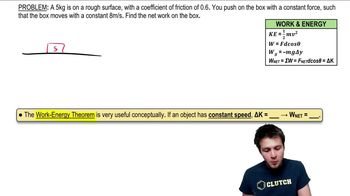
The work-energy theorem relates net work to the change in kinetic energy, so you only need the object's mass and its initial and final speeds. This method does not require information about individual forces or their directions.
What does a positive value for net work indicate about the motion of an object?
A positive net work means that the object's kinetic energy has increased. This typically corresponds to the object speeding up.
In the context of the work-energy theorem, what does the term 'delta k' represent?
'Delta k' represents the change in kinetic energy, calculated as the final kinetic energy minus the initial kinetic energy. It quantifies the energy gained or lost by the object due to net work.
Why is it unnecessary to know the direction of motion when using the work-energy theorem to find net work?
The work-energy theorem depends only on the magnitudes of the initial and final speeds, not their directions. This is because kinetic energy is a scalar quantity.