Newton's First & Second Laws definitions Flashcards
Newton's First & Second Laws definitions
2 students found this helpful You can tap to flip the card.
Control buttons has been changed to "navigation" mode.
1/15
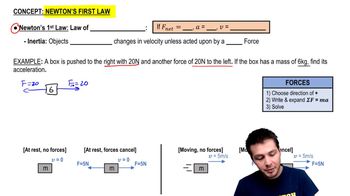
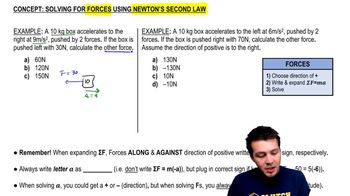
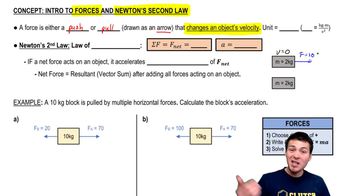
ForceA push or pull that changes an object's velocity, represented as a vector.NewtonThe unit of force in the International System of Units, symbolized as N.AccelerationThe rate of change of velocity of an object, influenced by net force.MassA measure of an object's resistance to acceleration when a net force is applied.Net ForceThe vector sum of all forces acting on an object, determining its acceleration.InertiaThe tendency of an object to resist changes in its state of motion.VelocityThe speed of an object in a specified direction, remaining constant if net force is zero.VectorA quantity with both magnitude and direction, used to represent forces.MagnitudeThe size or amount of a vector quantity, such as force or acceleration.DirectionThe line or path along which something moves, points, or faces.Positive DirectionThe chosen reference direction for vector calculations, typically right or up.Newton's First LawAn object remains at rest or in uniform motion unless acted upon by a net force.Newton's Second LawThe net force on an object is equal to the mass of the object multiplied by its acceleration.Vector AdditionThe process of combining vectors to determine the net force.Law of InertiaAnother term for Newton's First Law, describing resistance to changes in motion.