What does inertia mean in the context of Newton's first law?
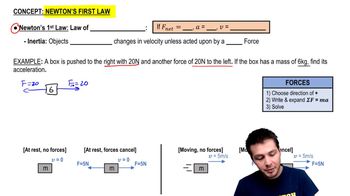
Inertia is the tendency of an object to resist changes in its velocity; objects with greater mass have greater inertia.
What is the standard unit of force in physics and what is its symbol?
The standard unit of force is the Newton, symbolized by a capital N. It is named after Isaac Newton.
How do you determine the net force when multiple forces act in opposite directions on an object?
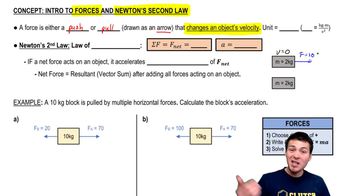
You add the forces in the direction of positive and subtract those in the opposite direction. The result is the net force acting on the object.
What does a negative acceleration value indicate when solving problems using Newton's second law?
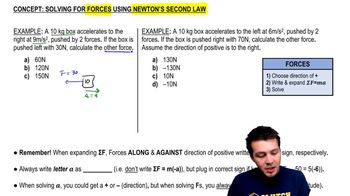
A negative acceleration means the acceleration is directed opposite to the chosen positive direction. The sign tells you the direction relative to your coordinate system.
When solving for an unknown force using Newton's second law, how do you indicate its direction in your answer?
You can indicate the direction by assigning a positive or negative sign based on the chosen positive direction. Alternatively, you can state the direction explicitly in your answer.
Why do moving objects not require a force to keep moving at constant velocity according to Newton's first law?
If the net force is zero, there is no acceleration, so the object continues moving at constant velocity. This means no force is needed to maintain constant motion in the absence of external forces.
What is the relationship between mass and acceleration for a given net force according to Newton's second law?
For a constant net force, increasing the mass decreases the acceleration. This is because acceleration equals net force divided by mass.
How do you choose the direction of positive when applying Newton's laws in problem solving?
You typically choose right and up as the positive directions. This choice helps consistently assign signs to forces and accelerations.
What happens to the acceleration of an object if the net force acting on it is zero?
If the net force is zero, the acceleration is also zero. This means the object's velocity remains constant.
When expanding the sum of all forces in Newton's second law, how are forces along and against the positive direction treated?
Forces along the positive direction are written with a plus sign, while those against are written with a minus sign. This ensures correct calculation of the net force.