Overview of Kepler's Laws definitions Flashcards
Overview of Kepler's Laws definitions
You can tap to flip the card.
Control buttons has been changed to "navigation" mode.
1/15
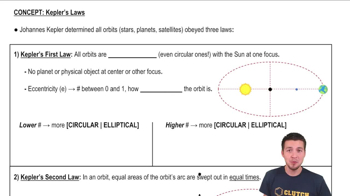
Johannes KeplerA German astronomer who formulated three fundamental laws of planetary motion.EllipsesGeometric shapes of orbits with two focal points, one of which is occupied by the sun.FociTwo fixed points in an ellipse, one of which is occupied by the sun in planetary orbits.EccentricityA measure of how much an orbit deviates from being circular, ranging from 0 to 1.Orbital PeriodThe time taken for a celestial body to complete one full orbit around another body.Orbital RadiusThe average distance from the center of an orbiting body to the center of the body it orbits.Kepler's First LawStates that all planetary orbits are elliptical with the sun at one focus.Kepler's Second LawDescribes how a line segment joining a planet and the sun sweeps out equal areas in equal times.Kepler's Third LawEstablishes a proportional relationship between the square of the orbital period and the cube of the orbital radius.Proportional RelationshipA consistent ratio between two quantities, such as T^2 and R^3 in Kepler's Third Law.Celestial BodiesNatural objects in space, such as planets, stars, and comets, that follow Kepler's laws.CometsCelestial objects with highly elliptical orbits, often with eccentricities close to 1.MassA property of a celestial body that influences the constant ratio in Kepler's Third Law.Constant RatioThe unchanging value of R^3/T^2 for planets orbiting the same star, dependent on the star's mass.Solar SystemThe collection of celestial bodies, including planets and comets, orbiting the sun.