Parallel Plate Capacitors definitions Flashcards
Parallel Plate Capacitors definitions
You can tap to flip the card.
Control buttons has been changed to "navigation" mode.
1/12
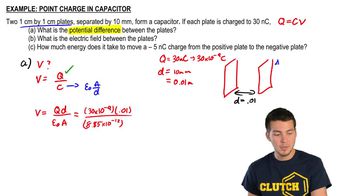
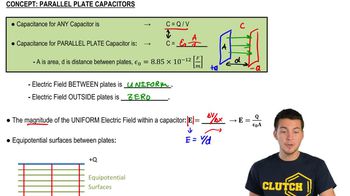
Parallel Plate CapacitorA device with two plates of equal and opposite charges separated by a distance, used to store electrical energy.CapacitanceThe ability of a capacitor to store charge per unit voltage, calculated as C = (epsilon_0 * A) / d.Vacuum PermittivityA constant denoted as epsilon_0, representing the ability of a vacuum to permit electric field lines.Electric FieldA uniform field between capacitor plates, calculated as E = Q / (epsilon_0 * A), indicating force per unit charge.Equipotential SurfacesSurfaces between capacitor plates where potential is constant and perpendicular to electric field lines.ChargeThe quantity of electricity held by a capacitor, calculated as the product of capacitance and voltage.VoltageThe potential difference between capacitor plates, influencing the electric field and charge storage.AreaThe surface size of capacitor plates, affecting capacitance and electric field strength.DistanceThe separation between capacitor plates, inversely affecting capacitance and electric field.Gauss's LawA principle relating electric fields to charge distribution, explaining uniform fields in capacitors.FaradThe unit of capacitance, representing the capacity to store one coulomb per volt.Newton per CoulombThe unit of electric field strength, indicating force exerted per unit charge.