What component in a hydraulic system converts fluid pressure into mechanical motion?
A piston converts fluid pressure into mechanical motion in a hydraulic system.
Which part of a hydraulic brake system applies hydraulic force to slow and stop a vehicle?
The pistons in the hydraulic brake system apply hydraulic force to slow and stop the vehicle.
Which fundamental law of hydraulics is used in hydraulic brake and lift systems?
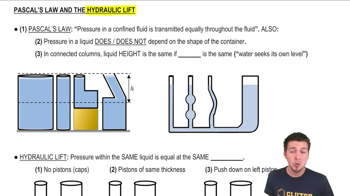
Pascal's law is used in hydraulic brake and lift systems. It states that pressure applied to a confined fluid is transmitted equally throughout the fluid.
What is the general equation to determine the force produced by a hydraulic system using two pistons of different areas?
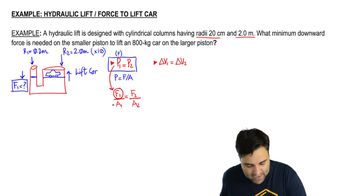
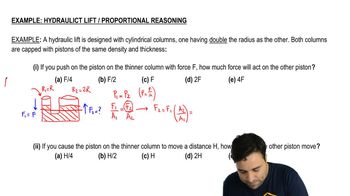
The force produced by a hydraulic system is given by F2 = F1 × (A2 / A1), where F1 is the input force, A1 is the area of the input piston, F2 is the output force, and A2 is the area of the output piston.
Why are liquids well suited for use in hydraulic systems?
Liquids are well suited for hydraulics because pressure applied to a confined liquid is transmitted equally in all directions, allowing for efficient force transmission and multiplication as described by Pascal's law.
How does the pressure at the bottom of a fluid column relate to the shape of the container?
The pressure at the bottom depends only on the depth, fluid density, gravitational acceleration, and top pressure, not the container's shape. This is a direct consequence of Pascal's law.
What happens to the fluid levels in connected columns when the pressure at the top is the same for all columns?
The fluid levels will equalize across all columns if the top pressure is the same. This demonstrates that pressure and fluid height are consistent in connected systems.
Why must pistons in a hydraulic lift typically have the same thickness?
Pistons must have the same thickness to ensure equal pressure distribution and proper leveling. If one piston is thicker, it would have more mass per area, causing imbalance.
What principle ensures that the volume of fluid displaced on one side of a hydraulic lift appears on the other side?
The conservation of volume principle (ΔV1 = ΔV2) ensures that fluid displaced from one side must appear on the other. This maintains the total volume of fluid in the system.
How does the mechanical advantage in a hydraulic lift affect the force and movement distance?
The mechanical advantage, given by the area ratio (A2/A1), multiplies the output force but reduces the movement distance by the same factor. This means a greater force is achieved at the cost of a shorter displacement.
How does a hydraulic device multiply force according to Pascal's law?
A hydraulic device multiplies force by using Pascal's law, which states that pressure applied to a confined fluid is transmitted equally throughout the fluid. In a hydraulic lift, two connected columns with different cross-sectional areas are used. When a force is applied to a small-area piston, it creates a pressure that is transmitted to a larger-area piston, resulting in a greater output force. The force multiplication factor is equal to the ratio of the areas (A2/A1), known as the mechanical advantage. Thus, the output force is multiplied by this ratio, allowing a small input force to lift a much heavier load.
 Back
Back

 05:13
05:13